

How shippers can overcome complex emission data structures
Sustainability managers from many shipping companies face fragmented emission data across ERP systems and business units. Read our article to gain insights into how you can enhance data accuracy and decarbonization insights while reducing manual effort to collect data.

Key Takeaways
- Fragmented shipper data (ERPs, country units, subcontractors) blocks decarbonization: inconsistent formats + unclear methods + manual Excel workflows = slow, unreliable reporting.
- The real risk is auditability: without knowing who calculated what, with which baseline/method, CSRD-style scrutiny triggers late remediation and weak defensibility.
- Three levers fix it: standardize inputs, standardize business logic (scopes, legs, baselines), and assign clear ownership/sign-off per country/unit.
Action checklist
- Enforce a single data template + field/type checks + anomaly flags at upload.
- Document the calculation rules (pre/post legs, scopes, baselines) and reconcile country totals vs. tradelane detail.
- Appoint data owners (stewards) and require periodic formal sign-off for audit trail.
Shipper emission data: Complex structures are holding back decarbonization efforts
Imagine this: it's mid-quarter again, and your sustainability team needs to report on transport emissions. You reach out to country units, wait for responses, receive data in three different formats, spot obvious inconsistencies, and spend weeks validating numbers that may or may not be correct. Sound familiar?
Most shipping companies today operate with fragmented data landscapes: Emission and transport information flows from multiple ERP systems, regional offices, different business units, and external subcontractors – each with their own data standards (or lack thereof). The contact persons providing this data might change, complicating things even further. Data formats often vary wildly: some files use calculations you don't understand; others rely on assumptions you've never questioned, and a few contain obvious errors that slip through the cracks.
Generic CSRD tools can't handle this complexity. In-house solutions might lack the sophistication to harmonize the data. And managing everything through Excel spreadsheets? That's not just inefficient – it's a compliance and accuracy nightmare. Sustainability teams often spend too much of their time on data validation rather than strategy development – a hidden productivity drain most companies don't measure.
Our work with sustainability managers across the shipping industry reveals two particularly telling scenarios:
- Hidden complexity in your ERP: One major shipper client maintains transport data across their ERP system but faces a critical visibility problem when it comes to logistics details. The system doesn't clearly differentiate transport structures – for example differentiating the use of sustainable fuel such as HVO (hydrotreated vegetable oil), intermodal solutions (e.g., by rail), or the use of standard diesel. When country units try to retrieve correct emission data, they either can't find it or find conflicting entries. Transport mode information that should be straightforward becomes a detective hunt. The problem behind it? Data structure. The information exists but remains buried in inconsistent hierarchies and undefined fields.
- Manual data entry across stakeholders: Another client struggles with a different pain point – multiple stakeholders within the same country provide transport data, sometimes for overlapping shipments. These inputs land in Excel files where they're manually entered, which can fast perpetuate errors across entire columns. The lack of ownership for the data entry negatively impacts data quality and verification of assumptions. The result is a spreadsheet where you can't trust a lot of the entries and discovering this only happens during spot-checks.
The cost of getting it wrong: beyond inaccurate numbers
When you can't trust your emission data, the consequences can cascade through your entire sustainability program. Your carbon reduction strategy is only as good as the data informing it.
When data comes from multiple sources, you often don't know how emissions were calculated. Specifically, the comparison to baseline figures effects overall emissions and reductions significantly and discrepancies between one country using a conservative methodology while another inflates baseline numbers poses consistency issues. Without transparency into calculation approaches, you can't benchmark progress towards externally communicated decarbonization goals accurately or defend your numbers during audit reviews.
CSRD and other regulatory frameworks demand accuracy and auditability. Sustainability managers increasingly face questions they can't answer: Who calculated this number? What methodology was used? Can you prove this data came from reliable sources? Manual processes and inconsistent data will leave you vulnerable. Late-stage discovery of data quality issues typically requires a few weeks of remediation during audit season – time your team likely doesn't have – and may significantly impact the results you are able to report to external stakeholders.
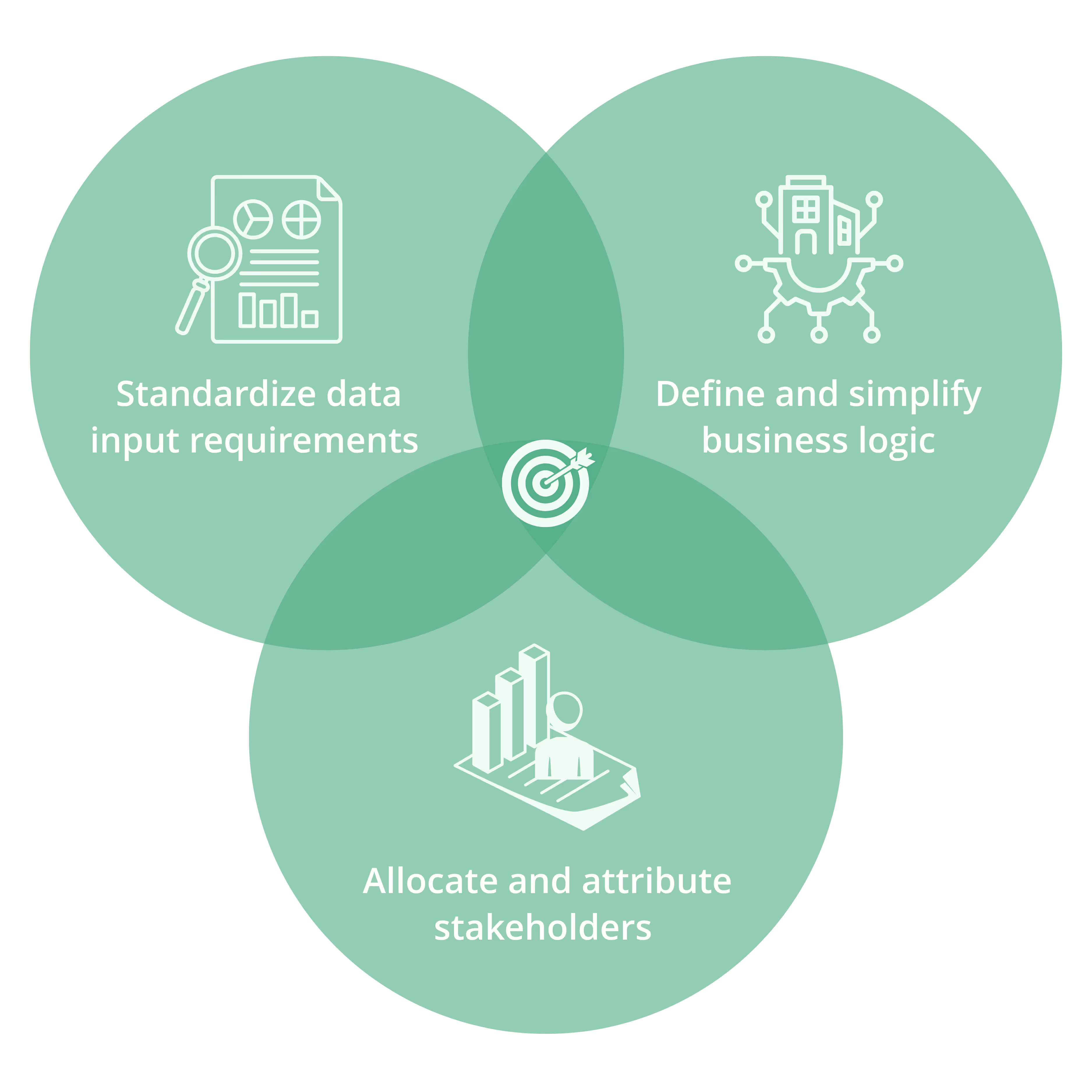
Three solution approaches to overcome challenges of complex data structures
By implementing the following structured data governance approaches, shippers will free sustainability teams to focus on strategy rather than firefighting:
1. Standardize data input requirements
Start with the highest-impact lever: Most companies see immediate gains by first focusing on standardizing fuel or vehicle type and transport mode data collection through dedicated templates and data type checks per data fields. Ensuring data type checks increases harmonization of inputs and provides a first layer to eliminate inputs that lack required information or provide an incoherent data type. This typically requires some weeks of process definition but can eliminate a significant amount of common data errors immediately.
Quick wins here build momentum and stakeholder buy-in for the more involved steps that follow. When country units upload transport data, automatic validation checks like flagging anomalies between countries or between quarters should prompt users immediately, creating self-awareness of errors before bad data spreads through your system.
The foundation is consistency. You need to standardize how data enters your system from the moment it's collected. Create a repeatable template that each country unit follows. The template should make clear which columns need completion, provide definitions for ambiguous terms, and include examples.
2. Define and simplify business logic
Don't leave calculation methodologies to chance. Define, document, and communicate the approach: How are pre- and post-legs calculated? Which scopes apply to which shipments? This transparency ensures everyone is speaking the same language and creates auditability for regulators.
Encourage procurement and logistics teams to provide information at the most granular level – the trade lane (origin-destination pair). Offer incentives for providing these details, such as reduced frequency of manual follow-ups, clearer visibility into their own logistics efficiency, or recognition in cross-functional dashboards. Make it faster and easier to enter data correctly than to skip steps.
Your SAP or other ERP system contains high-level shipment data (origin, destination, weight, customer). Systematically enrich this information with transport details using realistic assumptions based on trade lane knowledge.
Create a reconciliation process: aggregate high-level country reports, then compare the results to detailed trade lane data. Discrepancies signal where you need to dig deeper.
3. Allocate and attribute stakeholders
Data quality doesn't improve through collective responsibility, but through specific accountability: Identify one person in each country who owns data accuracy and timeliness. This person should have authority to enforce standards, access to necessary information, and recognition for delivering quality data. This shouldn't be treated as an annoying add-on task; positioning it as a core responsibility that impacts company-wide sustainability goals changes the dynamic.
Country units often view data reporting as an additional burden. Frame it as reducing their manual work (fewer follow-up requests, clearer templates, automated validation catches errors early). Positioning data quality as enabling their logistics decisions - not policing them - is essential for adoption. Pro tip: Consider appointing data stewards from within country units rather than assigning accountability from headquarters. Distributed ownership often generates faster adoption and better local data quality.
Have each country frequently and formally approve the data they've submitted. This sign-off creates a documented trail essential for audit processes. When someone with authority certifies data accuracy, it becomes defensible. More importantly, this ritual reinforces the importance of data quality and catches errors before they propagate.
To fulfill regulatory requirements, define clearly: Who is responsible for Scope 3.4 (upstream transportation)? Who owns Scope 3.9 (downstream transportation)? Which division handles subcontractor emissions? Auditors will ask not just for emission numbers but for your calculation methodology and data source documentation. Defining clear responsibility ensures you can provide auditors with a complete chain of custody for your numbers. Document these decisions early – ambiguity about responsibility is one of the top reasons companies fail audits.
Conclusion
Your decarbonization strategy's success depends on knowing what actually works. And your regulatory compliance depends on having a defensible, auditable process. Define success with metrics like these: (1) Time to compile quarterly emissions report, (2) % of data flagged as anomalies, (3) % of country signoffs completed on schedule, (4) Auditor findings related to data quality. Track these quarterly to maintain momentum and demonstrate value to leadership.
The payoff for implementing these solution approaches is substantial: accurate data that you can trust, decarbonization initiatives you can prove work, and audit readiness that protects your company.
Download our white paper and gain insights into why shippers need maximum data quality for their CO2 reduction efforts in the supply chain.
To learn how your company can deal with complex emission data structures, please get in touch with one of our industry experts.


Related articles