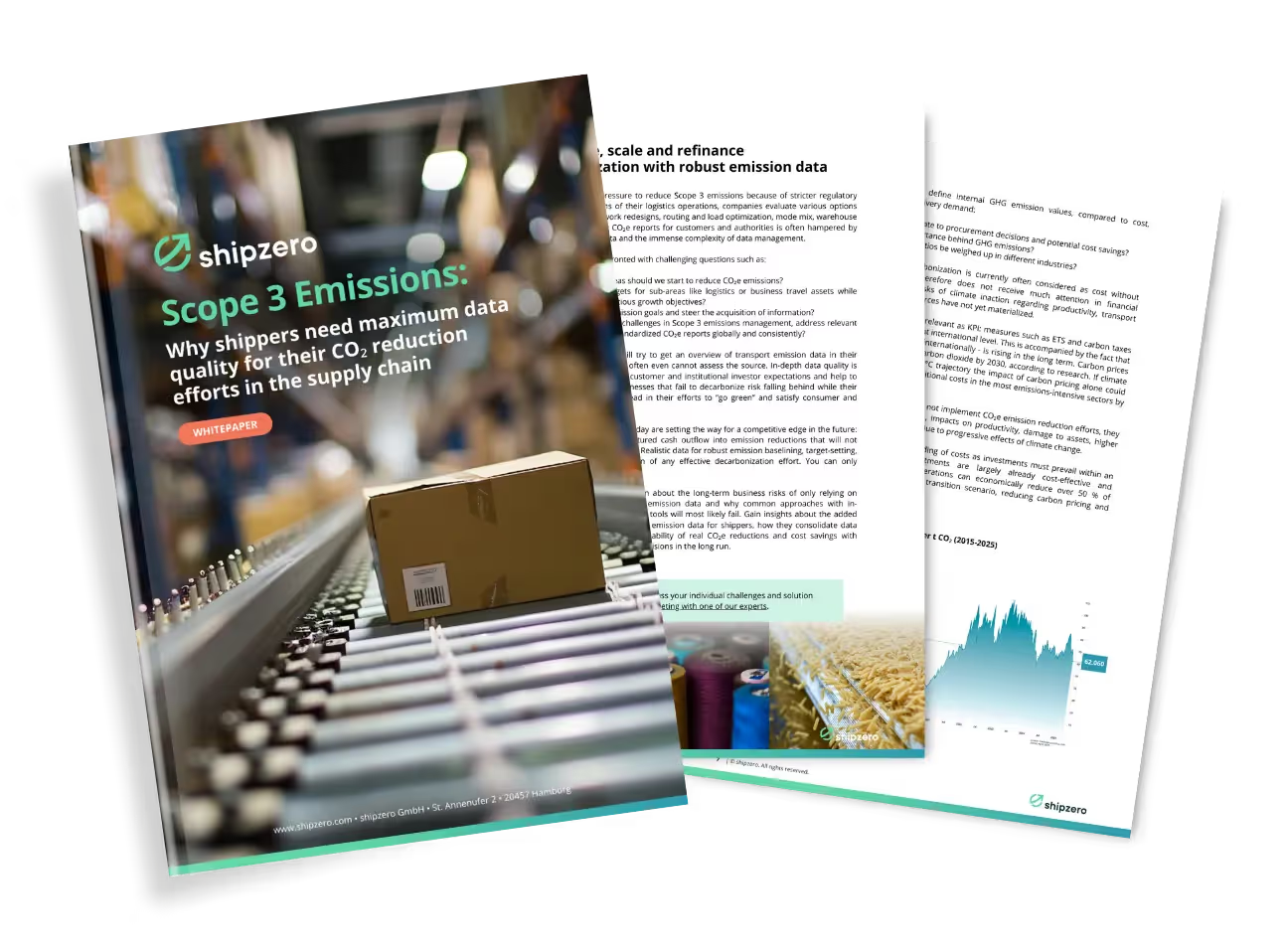
Scope 3 Emissions: Why Cargo Owners Need Maximum Data Quality to cut logistics CO2e
Most cargo owners face mounting pressure to cut Scope 3 logistics emissions, but cannot get an accurate picture of them in the first place: transport emissions data sits scattered across carriers, formats, and systems, and in-house teams or generic CSRD tools rarely close that gap. This guide explains why the data quality problem persists, why the common fixes fall short, and the six-step approach cargo owners need to build a future-proof emissions data structure, aligned with ISO 14083 and the GLEC Framework.
The most important facts
- Scope 3 logistics emissions typically make up the largest share of a cargo owner's transport-related footprint, yet many cannot even get a reliable overview of it across their carrier base.
- Carbon pricing alone could add costs equivalent to 50 percent of EBITDA for unprepared, emissions-intensive companies by 2030 (World Economic Forum).
- A 40 to 50 percent reduction in logistics emissions is achievable by 2030 using technology already available today (McKinsey & Company).
- In-house solutions and generic CSRD tools both tend to fail cargo owners: in-house builds are hard to scale and verify, while generic tools rely on average emission factors that are rarely ISO 14083 compliant.
- A future-proof Scope 3 data structure follows six steps, from selecting an expert solution provider to automating and scaling emissions reporting.
Who this guide is for
This guide is written primarily for cargo owners whose sustainability, logistics, and procurement teams need to reduce Scope 3 transport emissions without first redesigning their carrier network or reporting systems. For carriers and logistics service providers, it sets out the data quality bar cargo owners are increasingly measuring them against.
Why is Scope 3 emissions data such a persistent problem for cargo owners?
Scope 3 logistics emissions are hard to manage because regulatory requirements keep tightening while the underlying transport data stays fragmented: it sits in multiple, non-synchronized ERP systems, is frequently limited to invoicing-relevant data points, and is often compiled manually in spreadsheets that headquarters cannot easily synthesize. Carbon pricing is adding a direct cost dimension to the problem on top of this: carbon pricing alone could add costs equivalent to 50 percent of EBITDA for unprepared, emissions-intensive companies by 2030.
The difficulty compounds when cargo owners rely on carriers for data: many carriers cannot yet deliver emissions reports in a validated, automated way, and smaller carriers in particular are not yet obliged to follow stricter CSRD regulation or to invest in alternative fuels. Buyers and sellers of transport services also differ widely in maturity, which makes it difficult to compare carriers in tenders using any commonly agreed decarbonization KPIs.
Why do in-house Scope 3 solutions struggle to scale?
In-house solutions struggle in three areas at once: compliance, data management, and data analytics. On compliance, in-house teams face long accreditation cycles, costly external quality verification against frameworks like the GLEC Framework and standards like ISO 14083, and no automatic adaptation to regulatory change. On data management, consolidating Scope 3 data from decentralized systems can take months or years, with manual input remaining a persistent source of error. On analytics, data quality suffers from missing or unreliable inputs, calculations based on averages instead of real primary data, and no plausibility-check process to catch errors before they reach a report.
Why do generic CSRD tools fall short for logistics emissions?
Generic, horizontal CSRD tools typically use default values with limited understanding of logistics processes and a restricted data backbone, which makes their results rough estimates that are rarely ISO 14083 compliant and unsuitable for management accounting. Cargo owners who build a decarbonization strategy on a generic tool's output risk basing real investment decisions on numbers that do not hold up to scrutiny, since emission methodologies and factors are constantly evolving and a one-off generic setup rarely keeps pace.
What happens when cargo owners do not have enough reliable transport emission data?
Insufficient transport emission data creates a specific set of business risks, not just an accuracy problem: poor decision-making based on a rough estimate of reality, higher costs from the conservative emission calculations that opaque data forces, and an inability to steer logistics partners effectively because sustainability goals cannot be built into tenders with any precision.
It also raises reputational and compliance exposure: a growing share of cargo owners now treat minimum sustainability scores as a precondition for a business relationship at all, and unverifiable environmental claims risk being read as greenwashing in sectors like FMCG and fashion, where consumers and regulators are both paying closer attention.
What does a future-proof Scope 3 data structure look like?
A future-proof approach to Scope 3 logistics emissions follows six steps. Cargo owners first select an expert solution provider, independently accredited against recognized standards, rather than a generic tool or a one-off in-house build. They then streamline data collection from existing systems, commonly through an API, SFTP server, or upload function, before the provider clarifies, cleans, enriches, and harmonizes that data, including the detailed plausibility checks that generic tools typically skip.
Cargo owners then review the modelled output against their own operational systems to catch misunderstandings early, before emissions are calculated using an accredited methodology that keeps pace with evolving regulation. The final step is automation: once the setup is finalized, new data should be processed frequently and semi-automatically, with data quality improving continuously rather than being re-verified from scratch each cycle.
What is the real cost of carbon inaction for cargo owners?
Carbon pricing is becoming a direct cost line, not an abstract policy risk: carbon pricing alone could add costs equivalent to 50 percent of EBITDA for unprepared, emissions-intensive companies by 2030, according to the World Economic Forum. Separately, McKinsey & Company finds a 40 to 50 percent reduction in logistics emissions achievable by 2030 using technology already available today. Read together, the two figures suggest that the cargo owners most exposed to carbon-pricing risk, in principle, also have meaningful room to cut emissions and reduce that exposure, though realizing it still depends on data quality good enough to act on.
Framing decarbonization spend as cost rather than investment is itself part of the problem: capital expenditure for decarbonization is often booked purely as cost because the risks of inaction, lower productivity, damaged assets, higher insurance costs, have not yet materialized for most companies, which understates the case for acting early.
How does shipzero help cargo owners reduce Scope 3 logistics emissions?
shipzero's emissions intelligence platform brings together data from TMS and ERP systems, telematics, and energy or fueling records into a single managed hub that handles emissions calculation, data enrichment, and data consolidation, then makes the result available to internal teams, clients and partners, and third-party verifiers. The methodology is accredited by the Smart Freight Centre as conforming with ISO 14083:2023 and in line with the GLEC Framework V3, and certified by GUTcert against the GHG Protocol Corporate Standard and ISO 14083:2023 for corporate carbon footprint calculations.
What the full white paper adds
The full white paper adds what a page cannot: the complete breakdown of why in-house and generic CSRD approaches fail across all three dimensions, a worked example of how raw shipment data gets filtered and cleaned before it reaches a report, the full six-step implementation detail, and the complete reference list behind every figure cited here, from carbon pricing data to McKinsey and World Economic Forum research.
Frequently asked questions
Why is Scope 3 emissions data quality such a challenge for cargo owners?
Transport emissions data for Scope 3 reporting is typically scattered across multiple carriers, non-synchronized ERP systems, and manual spreadsheets, with little consistency in format or methodology. Building an accurate baseline requires consolidating and clarifying that data before any emissions calculation can be trusted.
Why do in-house solutions struggle to scale Scope 3 reporting?
In-house solutions face three compounding problems: long, costly accreditation cycles for compliance, resource-intensive manual data consolidation, and data analytics that suffer from missing, unreliable, or average-based inputs rather than real primary data.
Why are generic CSRD tools not sufficient for logistics emissions?
Generic CSRD tools use default emission values with limited understanding of logistics-specific processes, producing rough estimates that are rarely ISO 14083 compliant and unsuitable as a basis for real decarbonization investment decisions.
What is the financial risk of carrying on with poor-quality emissions data?
Carbon pricing alone could add costs equivalent to 50 percent of EBITDA for unprepared, emissions-intensive companies by 2030, according to the World Economic Forum, while poor data quality separately drives higher costs through overly conservative emission estimates and lost tenders tied to minimum sustainability scores.
What does shipzero's six-step approach to Scope 3 data involve?
The six steps are: selecting an accredited expert solution provider, streamlining data transfer from existing systems, clarifying and harmonizing the data, reviewing the modelled output against operational systems, calculating emissions using an accredited methodology, and automating and scaling the process over time.
Who is this guide for?
The guide is written primarily for cargo owners whose sustainability, logistics, and procurement teams need to reduce Scope 3 transport emissions, and secondarily for carriers and logistics service providers who want to understand the data quality bar cargo owners are increasingly measuring them against.
About this white paper
Published by shipzero, Hamburg, 2025. English.
Further reading
- Fact sheet: 5 steps to better carbon emissions reporting – https://www.shipzero.com/downloads/fact-sheet-5-steps-emissions-reporting
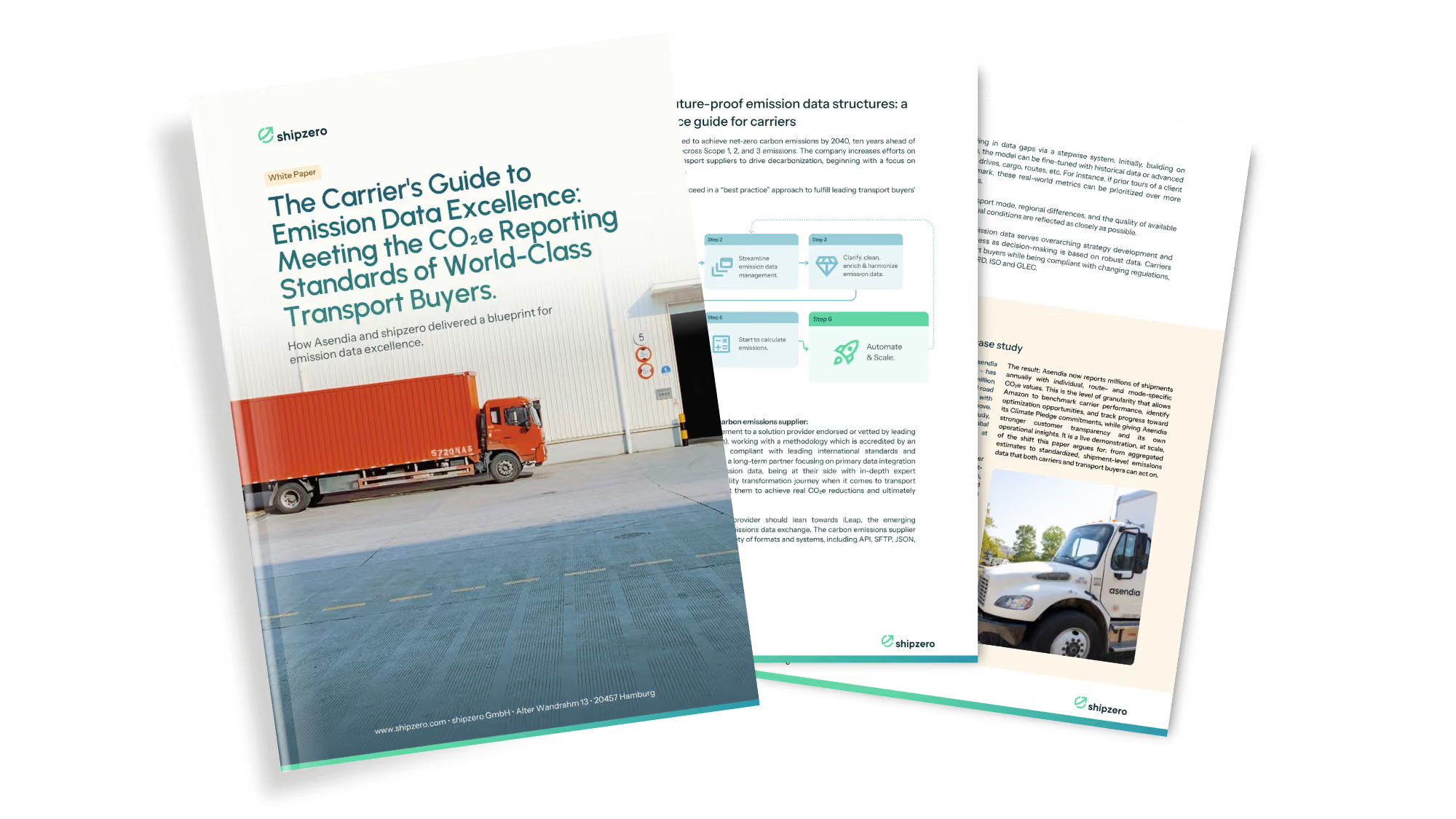
- White paper: The Carrier's Guide to Emission Data Excellence – https://www.shipzero.com/downloads/white-paper-emission-data-excellence-carrier-guide
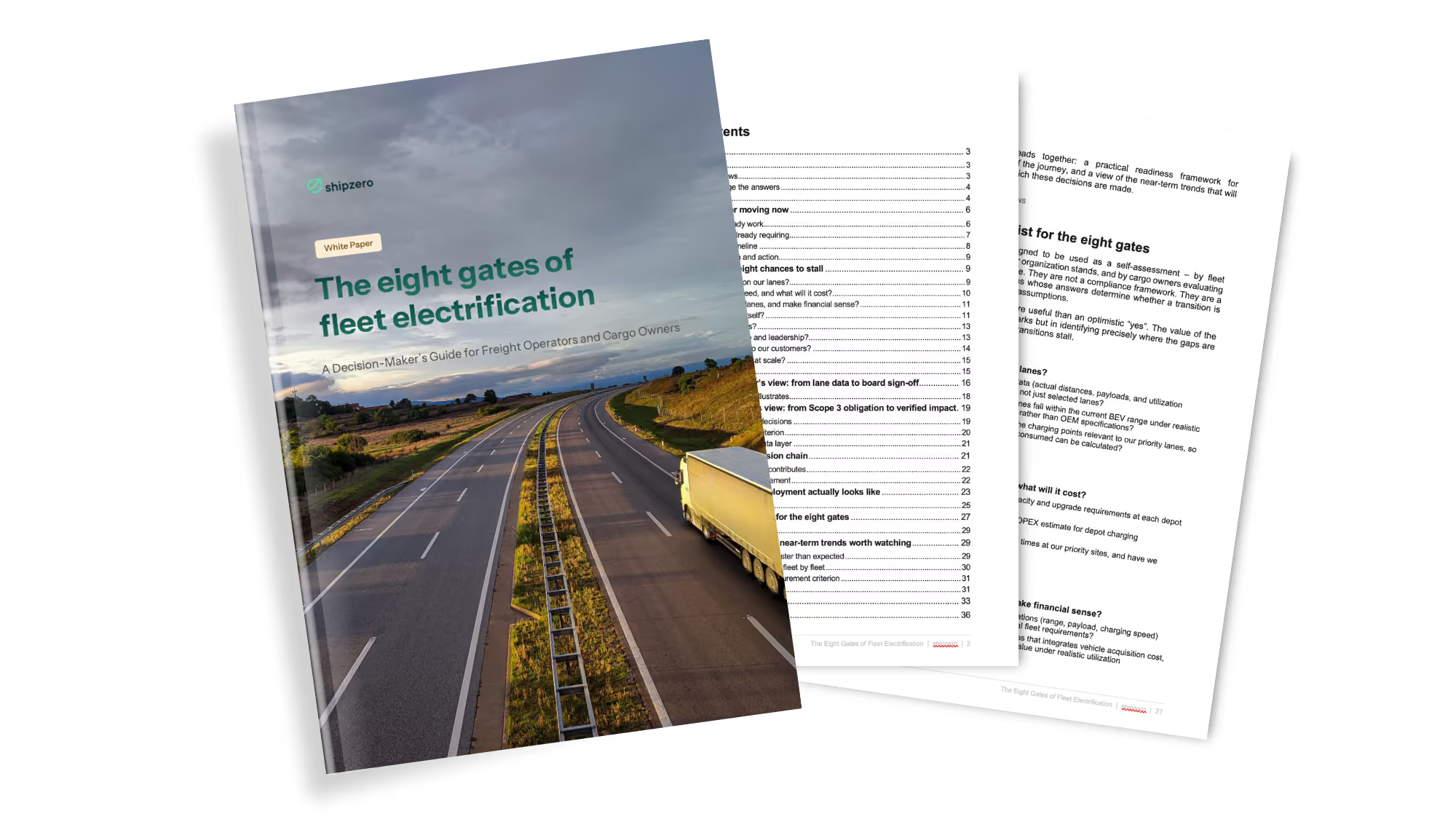
- White paper: The Eight Gates of Fleet Electrification – https://www.shipzero.com/downloads/white-paper-eight-gates-fleet-electrification
- Rittal case study: from trade lane visibility to data-driven action – https://www.shipzero.com/case-studies/rittal-carbon-accounting-trade-lane-visibility
- Pflaum case study: from transport transparency to a complete corporate carbon footprint – https://www.shipzero.com/case-studies/pflaum-corporate-carbon-footprint
- Blog: CountEmissionsEU is in force, what it actually means for cargo owners and LSPs – https://www.shipzero.com/blog/countemissionseu-what-it-means-cargo-owners-lsps
- Downloads overview page – https://www.shipzero.com/downloads
Used by the world's leading companies






More resources you'll find valuable