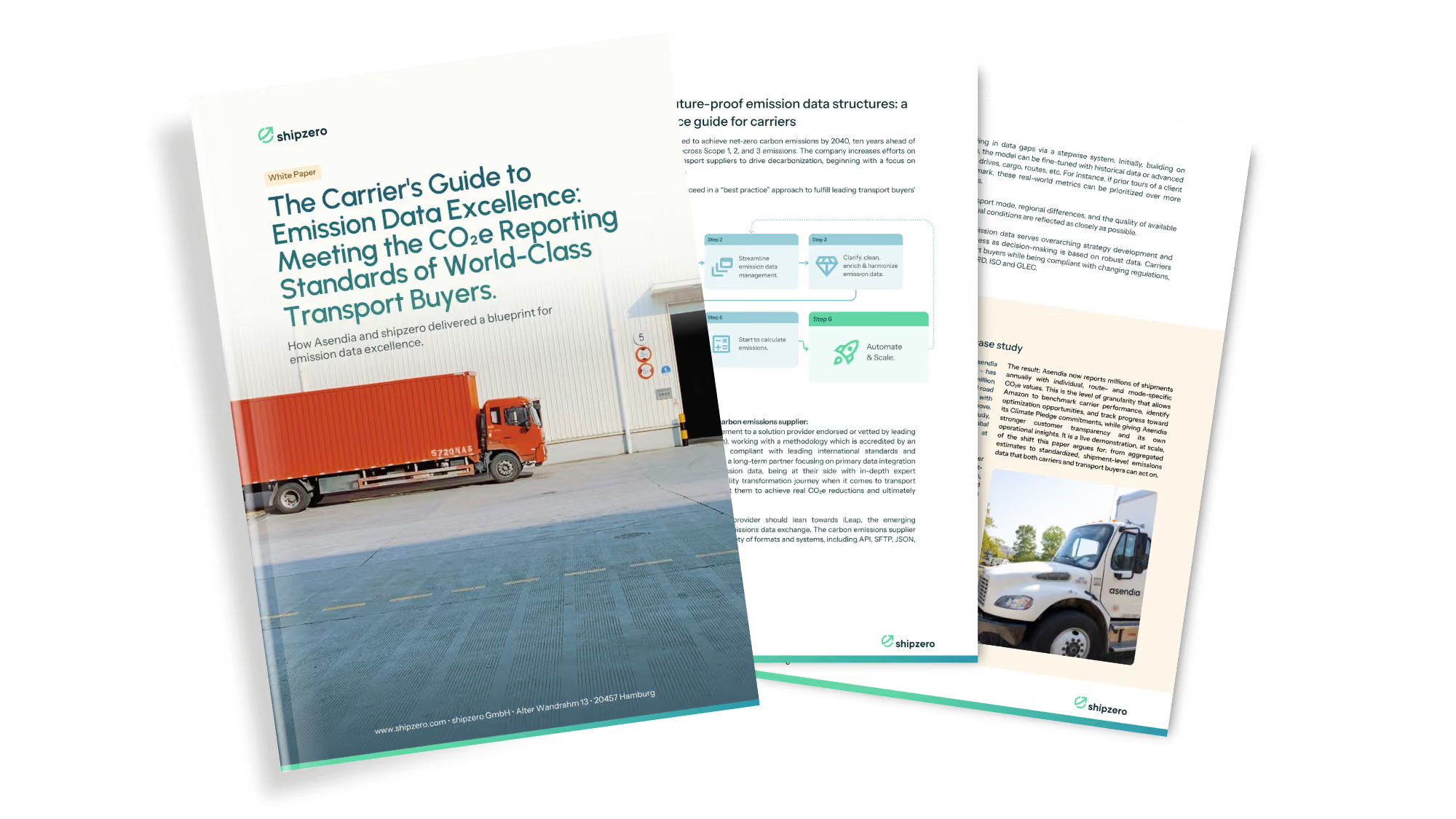
The Carrier's Guide to Emission Data Excellence: Meeting the CO₂e Reporting Standards of World-Class Transport Buyers
Major transport buyers like Amazon now expect carriers to deliver standardized, shipment-level CO2e data, not rough averages, and most carriers cannot yet produce it. This guide sets out a six-step, best-practice approach for building that data capability, aligned with ISO 14083 and the GLEC Framework and the emerging iLEAP data-exchange standard, proven in practice through Asendia's work processing Amazon's logistics emissions data.
The most important facts
- Amazon, one of the world's largest transport buyers, could not reliably benchmark its carriers' CO2e emissions without standardized, shipment-level data.
- Carriers reporting emission data of unknown methodology risk losing tenders, as minimum sustainability scores become a precondition for business relationships.
- iLEAP, the open data exchange standard built on the GLEC Framework and ISO 14083, is emerging as the common language for shipment-level emissions data; shipzero itself is an iLEAP Approved provider (Approval ID iLEAP-APP-0003), with full conformance for Shipment Footprint, TOC and HOC exchange, effective since August 2026.”
- Asendia now reports millions of shipments annually to Amazon with individual, route- and mode-specific CO2e values, documented in a case study Amazon published in July 2026.
- A future-proof emissions data structure follows six steps, from selecting an independently vetted carbon emissions supplier to automating and scaling reporting.
Who this guide is for
This guide is written primarily for carriers and logistics service providers who need to meet the emission-data requirements of large, sophisticated transport buyers, and want a concrete path for getting there rather than a general sustainability pitch. For cargo owners and transport buyers, it sets out the standard of data quality to expect from carriers, and how a leading buyer like Amazon put that standard into practice.
Why is global emission data exchange so difficult for carriers and transport buyers?
Accurate, consistent CO2e data is the precondition for comparing carriers fairly, and without it, large transport buyers cannot benchmark carrier emissions across trade lanes and regions. The difficulty is structural: carriers and transport buyers report at different hierarchy levels (account, trip, parcel), and emission classes, vehicle categories, and fuel blends are not consistently defined across regions.
iLEAP, an open data exchange standard built on the GLEC Framework and ISO 14083, is emerging as a common structure for submitting individual emission data in a comparable, shipment-level format, addressing the format differences that make carrier data hard to compare.
How does poor logistics data make emission reporting harder for carriers?
Most carriers are overburdened by emission data management because their telematics are not integrated with the transport management systems that hold shipment and customer data, so they cannot allocate emissions to individual shipments or customers. Much of this data still sits in error-prone spreadsheets, built through manual work, with no verified calculation methodology behind it.
Without a technological foundation for sharing validated, correctly formatted data, carriers cannot meet transport buyers' requirements, and buyers cannot rely on commonly agreed decarbonization KPIs to compare carriers in tenders, widening the gap between what buyers like Amazon need and what most carriers can currently deliver.
What happens when a carrier reports inaccurate or incomplete emission data?
Inaccurate or incomplete emission data costs carriers business, not just accuracy: transport buyers increasingly set minimum sustainability scores as a precondition for any further business relationship, and carriers who cannot provide credible data lose out in tender processes. Poor data quality also pushes cargo owners toward conservative, higher emission estimates, understating a carrier's actual operational improvements.
The broader risks include unrealistic sustainability targets, reputational harm in emissions-sensitive sectors like FMCG and fashion, and a reduced ability to anticipate supply chain disruptions, none of it visible without granular emissions data.
What should carriers look for in a carbon emissions supplier?
Carriers should assign emission data management to a solution provider that is independently vetted or endorsed by leading transport buyers, with a methodology assessed by an independent authority against recognized standards, rather than building a one-off integration in-house. The right long-term partner focuses on integrating primary data and brings in-depth, current expertise in transport emission management, supporting carriers toward real CO2e reductions and cost savings, not just a compliance report.
The provider's data model should lean toward iLEAP, the emerging international standard for logistics emissions data exchange, and should handle data in whatever format a carrier's systems actually produce it: API, SFTP, JSON, CSV, or Excel.
How do you streamline Scope 3 transport emission data management?
Accounting for Scope 3 transportation emissions requires accurate activity and GHG-intensity data from the third-party carriers moving goods on a transport buyer's behalf. Where that data is not available, the provider needs sharable metadata and substantiation so it can still be used in the buyer's corporate footprint, mapped to the specific transport buyer's requirements: Amazon, for example, requires both trip-level and parcel-level reporting, with parcel-level the more demanding of the two.
How do you clean, enrich, and harmonize emission data?
Once inconsistencies in the underlying data are identified, detailed plausibility checks should follow before any emission calculation happens, since calculating on unreliable inputs only produces a more precisely wrong number. The solution provider then enriches the raw data with the additional information emission calculation actually requires, rather than asking the carrier to supply a complete dataset upfront, turning fragmented, inconsistent source data into a dataset a verified methodology can be applied to.
Why does modelled emission data need review before it is used?
After data is connected, cleaned, and harmonized, carriers should review the modelled output and compare it against their own operational source systems, rather than treating the modelled figures as final. This step exists to catch misunderstandings early: a modelled result that does not match what a carrier actually knows about its own operations is a signal that an input was wrong, not that the model should simply be trusted.
How do you calculate transport emissions carriers can stand behind?
With the data modelling finalized, emissions can be calculated and reviewed again, using an independently assessed methodology rather than a generic or self-built calculation approach. Regulation, standards, and emission factors keep changing, so the provider needs deep, current expertise in the underlying methodology, not a calculation that was accurate when first built and has not been revisited since.
How do you automate and scale emissions reporting?
Once the setup is finalized, new data should be processed frequently and semi-automatically rather than manually re-run each time, with data quality improving continuously. Carriers should treat this as a tender-readiness question as much as a reporting one: errors such as wrong weights, mismatched location codes, or unrealistic transport modes affect a carrier's credibility, not just its reporting accuracy.
Integrating primary data, such as a vehicle's real fuel consumption, makes emissions data more meaningful over time: energy-based calculations are the most precise and remove the need for fuel-specific assumptions, always on a consent basis for how that data is used. Carriers with lower data availability can still be evaluated comparably through a stepwise system of default values, refined as better input data becomes available.
What does the Asendia case study prove in practice?
Since 2025, Asendia, one of Amazon's international logistics carriers, has commissioned shipzero to process several million shipment data batches per month across its global road and air network for its business with Amazon, applying the approach set out above. shipzero mapped and structured shipment-level data, including weight, dimensions, origin and destination, transport mode, vehicle and fuel type, distance, and load factors, directly from Asendia's internal systems, with automated checks flagging implausible values before the data reached Amazon.
The result, documented in a joint case study published by Amazon in July 2026, is that Asendia now reports millions of shipments annually with individual, route- and mode-specific CO2e values, giving Amazon the granularity to benchmark carrier performance and track progress toward its Climate Pledge commitment to reach net-zero carbon emissions by 2040, ten years ahead of the Paris Agreement.
What the full white paper adds
The full white paper adds what a page cannot: the detailed complexities behind each data exchange challenge, the complete six-step methodology with implementation detail, further context on the Asendia case study, and the full reference list behind every claim made here, from Amazon's Climate Pledge to the GLEC Framework and ISO 14083.
Frequently asked questions
Why can't transport buyers like Amazon compare carriers' emissions data directly?
Carriers typically report emissions at different levels of detail (account, trip, or parcel), using emission classes, vehicle categories, and fuel definitions that are not consistent across regions, so figures from different carriers are rarely comparable as reported. A standardized data exchange format, such as iLEAP, is what makes that comparison possible.
What is iLEAP, and why does it matter for emissions reporting?
iLEAP is an open data model for exchanging logistics emissions data, built on the GLEC Framework and ISO 14083, and is emerging as a common structure for submitting shipment-level emissions data in a format transport buyers can compare across carriers. It addresses the format and hierarchy differences that otherwise make carrier data incomparable.
What data does a carrier need to report accurate Scope 3 transport emissions?
Accurate reporting needs activity and emissions-intensity data at shipment level: weight, dimensions, origin and destination, transport mode, vehicle and fuel type, distance, and load factors, mapped to the transport buyer's specific requirements. Where primary data is not available, a validated calculation approach with sharable metadata is the next-best foundation, not a fleet-wide average.
How many shipments does Asendia process for Amazon using this approach?
Asendia reports millions of shipments annually to Amazon with individual, route- and mode-specific CO2e values, built on a joint case study published by Amazon in July 2026.
What is Amazon's net-zero commitment, and how does carrier data support it?
Amazon has committed to reach net-zero carbon emissions by 2040, ten years ahead of the Paris Agreement, across Scope 1, 2, and 3 emissions. Standardized, shipment-level carrier data is what lets Amazon benchmark carrier performance, identify optimization opportunities, and track progress toward that commitment, rather than relying on aggregated estimates.
Who is this guide for?
The guide is written primarily for carriers and logistics service providers who need to meet large transport buyers' emission-data requirements, and secondarily for cargo owners and transport buyers who want to understand the standard of data quality to expect from their carriers.
About this white paper
Published by shipzero, Hamburg, 2026. English. Features the Asendia case study published jointly with Amazon in July 2026.
Further reading
- Amazon Sustainability Exchange: Standardizing emissions data to decarbonize global logistics – https://sustainabilityexchange.amazon.com/focus-areas/transportation/case-study/standardizing-emissions-data-to-decarbonize-global-logistics
- Nagel-Group case study: building a verified emissions data foundation – https://www.shipzero.com/case-studies/nagel-group-book-and-claim-scope-3
- ZUFALL logistics group case study: from data foundation to fleet action – https://www.shipzero.com/case-studies/zufall-co2-emissions-control-sustainable-logistics
- Blog: the EU Omnibus Package and its impact on sustainability reporting – https://www.shipzero.com/blog/omnibus-package-impact-sustainability-reporting
- Blog: why primary data is crucial for measuring CO2 emissions in transport and logistics – https://www.shipzero.com/blog/primary-data-in-transport-and-logistics
- White paper: The Eight Gates of Fleet Electrification – https://www.shipzero.com/downloads/white-paper-eight-gates-fleet-electrification
- Downloads overview page – https://www.shipzero.com/downloads
Used by the world's leading companies






More resources you'll find valuable