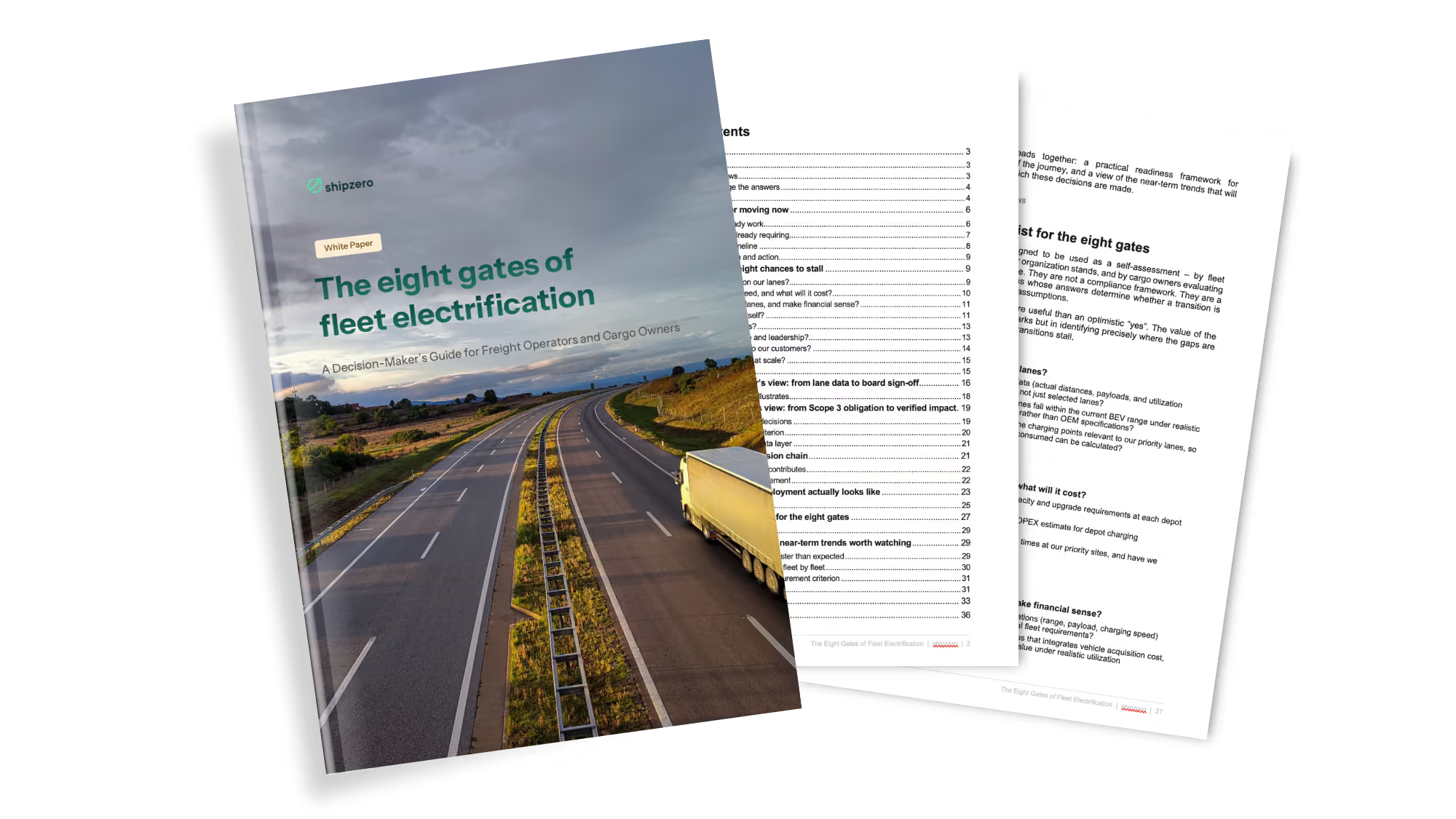
The eight gates of fleet electrification: A Decision-Maker's Guide for Freight Operators and Cargo Owners
Battery-electric trucks are a deployment decision today, not a future bet. On the right lanes, the economics already work, and the obstacle is rarely the vehicle technology itself. It is a sequence of eight decisions that most logistics service providers and cargo owners cannot resolve with the data they currently have. This guide walks through all eight gates, from lane-level data to board sign-off.
The most important facts
- Battery-electric total cost of ownership already beats diesel on the best depot-to-depot lanes and is projected to do so fleet-wide by 2030 (France Supply Chain / EdEn modelling, 2026).
- Battery-electric trucks are already about 55% more energy-efficient than diesel equivalents, with EU fuel costs roughly a third lower (IEA Global EV Outlook 2025).
- Grid connection for depot charging is the most underestimated constraint, with lead times commonly running 18 to 24 months.
- Germany's toll exemption for zero-emission trucks is confirmed in force through 30 June 2031.
- SBTi's Corporate Net-Zero Standard V2.0 (June 2026) tightens Scope 3 transport reporting, and industry coverage of the standard describes it as recognizing Book & Claim as one mechanism for transport decarbonization, alongside direct reduction.
Who this guide is for
For logistics service providers, this guide is a roadmap for turning fleet electrification into a tender advantage and a new revenue line through Book & Claim, not just a cost decision. For cargo owners, it is a guide to verifying carrier emissions claims and allocating decarbonization budget to the carriers and lanes that genuinely reduce Scope 3 Category 4 emissions, rather than to whichever carrier reports the best-looking label.
Which lanes are suitable for battery-electric trucks?
Lane suitability depends on the actual distance, payload, utilization, and charging access of a specific route, not on a vehicle's advertised range. Depot-to-depot lanes, where a truck returns to a controlled charging environment at the end of each cycle, are the clearest starting point.
OEM's brochure figures and industry averages cannot answer this question; it requires granular, route-level analysis of an operator's own transport data. Nagel-Group, a European food logistics provider operating roughly 7,000 vehicles, found that fixed-route, depot-charged services suited its electric tractor-trailers best. “Start with the data, not the vehicle,” advises Bastian Seidel, the company's Fleet Innovation Manager. Its tractor-trailers now reach daily ranges of 600 to 800 kilometers in two-shift operation, with a recorded maximum of 1,060 kilometers. The common failure mode is assessing lane suitability from OEM range specifications rather than real route data, then discovering operational problems only after capital has already been committed.
What charging infrastructure does a BEV fleet need, and what does it cost?
Depot charging is the foundation of any BEV deployment, and its cost has to be modelled site by site, not as a fleet-wide average. Grid connection upgrades, hardware, installation, and ongoing electricity costs vary by location, and lead times for new grid connections commonly run 18 to 24 months at some sites, a constraint operators frequently underestimate until it delays a deployment that already has vehicles on order.
The public charging network is expanding to support longer lanes: the European Alternative Fuels Observatory counted 373 operational heavy-duty charging locations across 21 countries as of its April 2026 update, with 2,405 charging points and 1,225 stations. Germany has approved roughly €1.6 billion for around 130 motorway charging hubs, and its Federal Ministry of Transport opened a further €1 billion national funding program for depot and public infrastructure in May 2026.
This gate is usually best answered with a dedicated charging infrastructure partner rather than an internal team.
Which vehicles fit the lanes, and make financial sense?
Vehicle selection only becomes a sound decision once it is matched against an operator's own lane data: a 400-kilometer-range truck looks different on a 150-kilometer depot-to-depot lane than on a mixed 300-kilometer regional route with variable payloads. What matters is which models cover a high share of an operator's priority lanes under realistic payload conditions, out of everything currently on the market.
Payload specifications, delivery timelines, leasing versus ownership structures, and residual value assumptions all feed into the total cost of ownership model. Battery-electric trucks are on a trajectory toward TCO parity with diesel on suitable routes by the late 2020s, though the exact crossover point varies by vehicle type, route profile, and energy contract. The common failure mode is choosing vehicles from OEM sales conversations and demo routes, then discovering payload or range limitations once deployed on the operator's actual lanes.
When does a battery-electric truck pay for itself?
A BEV investment that clears the first three gates still needs a finance-grade business case before capital approval, built on an operator's own lane data rather than industry averages, since generic assumptions are the most common reason finance teams reject otherwise sound BEV cases. Depot access, not vehicle choice alone, decides the economics: a 2026 study of 44-tonne long-haul tractor-units by France Supply Chain and EdEn puts depot charging at around €0.14 per kWh against roughly €0.40 for en-route charging, and projects full BEV total cost of ownership falling to approximately €0.71 per kilometer by 2030 against €0.84–€0.85 for diesel, narrowing from near parity in 2025.
The business case should also integrate sensitivity analysis across utilization and energy-price scenarios, not a single point estimate, and should include the revenue side: green freight premiums and, covered next, Book & Claim.
How does Book & Claim strengthen the BEV business case?
Book & Claim lets operators who already run BEVs monetize the low-emission kilometers they generate; it is a commercial layer on top of deployment, never a prerequisite for it. An operator books verified emission reductions from BEV operations into a certified registry; a cargo owner customer claims those reductions for their own Scope 3 Category 4 or Category 9 reporting, independent of which physical shipment ran on the electric vehicle.
The evidentiary foundation is charging data rather than fuel certificates: charge point records, renewable electricity contracts, and allocation logic linking charging events to transport operations, validated by an accredited third party against the Market-Based Measures framework. Verified reductions are commonly discussed in the region of up to approximately €150 per tonne of CO2e in cargo owner contracts, a directional figure, not a guaranteed rate. Operators who have built the data infrastructure for the gates above are already close to Book & Claim readiness.
Do battery-electric trucks help win freight tenders?
For logistics service providers, BEV capability only becomes a tender advantage when it comes with lane-specific CO2e comparisons on a methodology cargo owners can trust, not a general green claim. Cargo owner procurement is increasingly embedding emissions requirements directly into carrier selection, and operators who cannot quantify their BEV impact at lane level are structurally disadvantaged.
An LSP that has already done the lane analysis and business case modelling above has most of what a tender submission needs; the remaining step is structuring that data into the format a specific cargo owner requires, since methodology and granularity vary by customer. The common failure mode is a submission that demonstrates BEV ownership but not lane-specific, ISO 14083-aligned CO2e comparisons, which loses credibility to a competitor who can substantiate its numbers.
How do you defend a BEV business case to finance and leadership?
A board-ready business case translates lane suitability and infrastructure data into the language finance evaluates payback period, return on investment, and risk-adjusted scenarios, not operational detail. This means scenario modelling across energy price trajectories, including the carbon-pricing effect once ETS2 reaches road transport fuel in January 2028, residual value, and utilization, presented as a range of outcomes with stated assumptions, not a single optimistic number. The common failure mode is a point estimate with no downside scenario, which finance sends back for revision, stalling the process for months.
How do sales teams sell green freight to customers?
Selling green freight credibly requires verified, lane-specific emissions data a sales team can explain and defend, not a label on top of an unverified claim. Most freight sales organizations were built around price, capacity, and service level, not carbon intensity, so this typically works best as a distinct commercial capability, alongside rather than instead of the core freight sales function. The more effective model prices the verified reduction as its own product against a cargo owner's decarbonization budget, separating the sustainability conversation from cost negotiation. The common failure mode is leading with the green label rather than the verified data.
How do you scale BEV operations and emissions reporting?
Once a BEV deployment is validated, financed, and commercially active, the remaining question is an infrastructure one: whether emissions data flows automatically from operations into reporting, customer systems, and audit outputs, without manual intervention that limits growth. For most operators, this means API integration between the transport management system, telematics, charging infrastructure, and the emissions accounting platform. Operators who invest early recover the cost through automated reporting and the ability to take on customers who need shipment-level CO2e data without adding overhead; the common failure mode is tracking the initial deployment manually, which works at pilot scale but becomes the bottleneck as the fleet grows.
What changes by 2030?
Three structural shifts are changing the calculus for all eight gates over the next three to five years. The charging corridor gap is closing faster than expected: the European Alternative Fuels Observatory recorded 373 operational heavy-duty charging locations across 21 countries as of its April 2026 update, alongside close to €2.6 billion in combined German federal funding for charging infrastructure approved between December 2025 and May 2026.
TCO parity is arriving lane by lane rather than fleet by fleet, as battery costs fall and utilization improves. The IEA's Global EV Outlook 2025 already puts battery-electric trucks at around 55% more energy-efficient than diesel equivalents, with EU direct fuel costs roughly a third lower at 2024 energy prices.
Carrier data quality is also becoming a procurement criterion in its own right: SBTi's Corporate Net-Zero Standard V2.0, published in June 2026, tightens Scope 3 transport reporting requirements, and the window in which a green label without verified data is commercially acceptable is closing.
What the full white paper adds
The full white paper adds what a web page cannot: direct interviews with Nagel-Group's Fleet Innovation Manager and ZUFALL logistics group's fleet management and sustainability leads, a practical eight-gate readiness checklist for self-assessment, the typical failure mode for each gate in detail, a glossary of abbreviations, and a complete, numbered reference list for every figure cited here, so every claim can be traced back to its primary source.
Frequently asked questions
When do battery-electric trucks become economically viable?
On depot-to-depot lanes with high utilization and overnight charging, battery-electric total cost of ownership is already close to diesel, and a 2026 France Supply Chain/EdEn study projects full parity by around 2030 for 44-tonne long-haul tractor-units. The crossover depends heavily on charging access, so the lanes that qualify today are generally fixed, depot-anchored routes rather than long-haul lanes dependent on public charging.
How long does a grid connection for depot charging take?
Grid connection lead times for new depot charging infrastructure commonly run 18 to 24 months at some sites, varying by local grid capacity. Because this often exceeds vehicle procurement time, operators who plan infrastructure only after ordering vehicles typically see deployment delayed at the infrastructure stage, not the vehicle stage.
What data do you need to identify BEV-suitable lanes?
Identifying BEV-suitable lanes requires route-level data on actual distance, payload, and utilization, plus the location and grid energy mix of available charging infrastructure, not OEM range specifications or fleet-wide averages. Depot-to-depot lanes, where a truck returns to a controlled charging environment for each cycle, are typically the clearest starting point.
What is Book & Claim, and how does it relate to electric trucks?
Book & Claim is a market-based mechanism that lets a logistics service provider book verified emission reductions, including from BEV charging data, into a certified registry, which a cargo owner then claims for their own Scope 3 reporting, independent of which physical shipment used the electric vehicle. For BEV fleets, it is a commercial multiplier on top of deployment, not a prerequisite for it.
How do you prove CO2e reductions to cargo owners under ISO 14083?
ISO 14083 is the international standard for quantifying and reporting greenhouse gas emissions across transport chains, and the GLEC Framework applies specifically to logistics. Proving a reduction under this methodology requires shipment-level emissions data, verified against the standard, with an auditable chain of custody back to the underlying records, not a fleet-average estimate.
What toll exemptions and subsidies exist for electric trucks in Germany?
Germany's toll exemption for zero-emission heavy-duty trucks is confirmed in force through 30 June 2031. On top of that, close to EUR 2.6 billion in combined federal funding was approved between December 2025 and May 2026 for motorway charging hubs and depot and public charging infrastructure, worth confirming with the Federal Ministry of Transport before relying on it for a specific investment case.
Who is this white paper for?
The guide is written primarily for logistics service providers planning or scaling a battery-electric fleet, and secondarily for cargo owners who need to verify their carriers' emissions claims and allocate decarbonization budget to the lanes and carriers that measurably reduce Scope 3 Category 4 emissions.
About this white paper
Published by shipzero, Hamburg. Originally released August 2026; this page last updated October 2026. 37 pages, English. Written by shipzero, with interviews conducted for Chapters 3 and 4.
Further reading
- Nagel-Group case study: from Book & Claim to BEV integration – https://www.shipzero.com/case-studies/nagel-group-book-and-claim-scope-3
- ZUFALL logistics group case study: 16 electric trucks in commercial operation – https://www.shipzero.com/case-studies/zufall-co2-emissions-control-sustainable-logistics
- Lorenz case study: from annual carbon reporting to carrier comparison – https://www.shipzero.com/case-studies/lorenz-case-study-carbon-accounting-emissions-intelligence
- Blog: the EU Omnibus Package and its impact on sustainability reporting – https://www.shipzero.com/blog/omnibus-package-impact-sustainability-reporting
- Fact sheet: Book & Claim for Battery-Electric Road Freight – https://www.shipzero.com/downloads/fact-sheet-book-claim-for-battery-electric-road-freight
- Blog: how to unlock CO2 reduction potential at trade-lane level – https://www.shipzero.com/blog/co2-reduction-supply-chain-tradelanes
Used by the world's leading companies






More resources you'll find valuable