Why transport companies report CO₂e emissions
Several business drivers make carbon emissions reporting a priority for logistics companies:
- Customer demand: Major shippers increasingly request emissions data from their logistics partners.
- Regulatory requirements: Regulations such as the Corporate Sustainability Reporting Directive (CSRD) require emissions reporting from companies in scope.
- Competitive advantage: Companies with good-quality emissions data can attract and retain customers who have sustainability objectives for their own supply chain.
- Cost reduction: Understanding emissions helps identify efficiency gains and cost-saving opportunities.
- Access to green financing: Transport and logistics companies with strong sustainability disclosure and performance may attract investors and funding where ESG criteria matter.
What is required for carbon emissions reporting in logistics?
Logistics companies can follow best-practice approaches by calculating and reporting transport emissions in accordance with ISO 14083 (the international standard for quantifying greenhouse gas emissions of transport chains), supported by the GLEC Framework of the Smart Freight Centre. The GHG Protocol is used to consolidate reporting at company level. These global standards are aligned with each other and enable reporting across the three GHG scopes:
- Scope 1: direct emissions from energy consumption in owned and/or operated assets, including vehicles and vessels.
- Scope 2: indirect emissions from purchased energy, such as electricity consumed in warehouses, offices or terminals, as well as by electric vehicles.
- Scope 3: indirect emissions from supply chain activities, including procured goods and subcontracted transport services. This scope is crucial for freight forwarders.
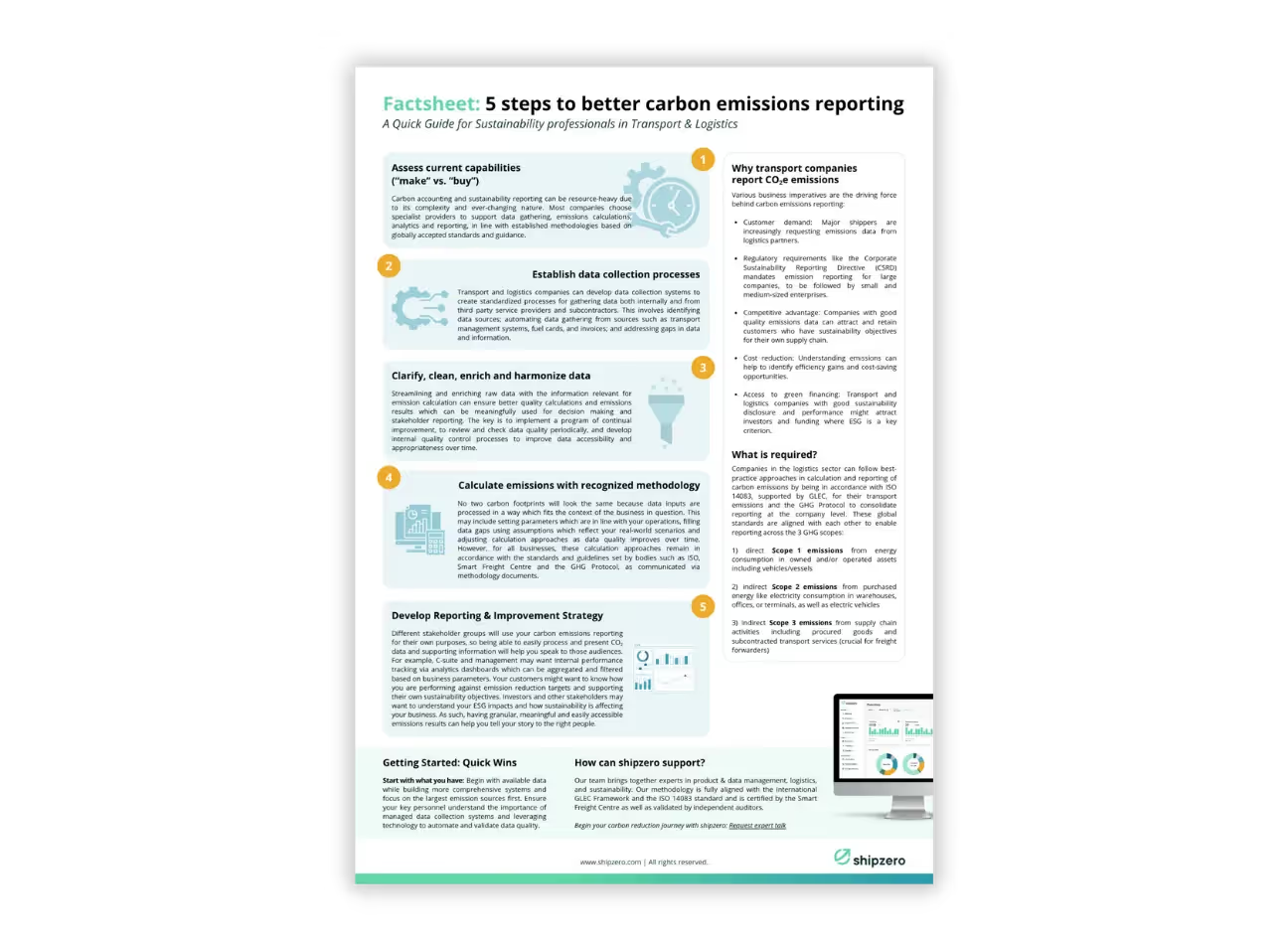
5 steps to better carbon emissions reporting
1. Assess current capabilities ("make" vs. "buy")
Carbon accounting and sustainability reporting can be resource-heavy because of their complexity and ever-changing nature. Most companies choose specialist providers to support data gathering, emissions calculations, analytics and reporting, in line with established methodologies based on globally accepted standards and guidance.
2. Establish data collection processes
Transport and logistics companies can build data collection systems that standardize how data is gathered, both internally and from third-party service providers and subcontractors. This involves identifying data sources, automating data gathering from sources such as transport management systems (TMS), fuel cards and invoices, and addressing gaps in data and information.
3. Clarify, clean, enrich and harmonize data
Streamlining and enriching raw data with the information relevant for emission calculation leads to better calculations and results that can be used meaningfully for decision-making and stakeholder reporting. The key is a program of continual improvement: review data quality periodically and develop internal quality control processes that improve data accessibility and appropriateness over time.
4. Calculate emissions with recognized methodology
No two carbon footprints look the same, because data inputs are processed in a way that fits the context of the business. This may include setting parameters in line with your operations, filling data gaps with assumptions that reflect real-world scenarios, and adjusting calculation approaches as data quality improves. For all businesses, however, the calculation approaches remain in accordance with the standards and guidelines set by bodies such as ISO, the Smart Freight Centre and the GHG Protocol.
5. Develop a reporting and improvement strategy
Different stakeholder groups use your carbon emissions reporting for their own purposes, so being able to process and present CO₂e data easily helps you speak to each audience:
- C-suite and management may want internal performance tracking via analytics dashboards that can be aggregated and filtered by business parameters.
- Customers may want to know how you perform against emission reduction targets and how you support their own sustainability objectives.
- Investors and other stakeholders may want to understand your ESG impacts and how sustainability affects your business.
Granular, meaningful and easily accessible emissions results help you tell your story to the right people.
Getting started: quick wins
Start with what you have. Begin with available data while building more comprehensive systems, and focus on the largest emission sources first. Make sure key personnel understand the importance of managed data collection systems and use technology to automate and validate data quality.









.svg)