

The Chasm: how logistics companies can benefit from early adopters
Logistics companies face a critical sustainability chasm where economic viability finally meets environmental responsibility. Read our analysis and gain insights why pragmatic decarbonization strategies, precise emission data management, and strategic timing create unprecedented competitive advantages in today’s evolving market.

Key Takeaways
- Logistics is in a “chasm”: sustainability matters, but short-term cost pressure blocks investment – until now, when economics and climate action start to align.
- Data is the bottleneck: many need sustainability data from transport partners, but few receive it; without transparent, comparable CO₂e data, decarbonization (and tender competitiveness) stalls.
- Pragmatic levers win now: electrification is becoming economically attractive; where not feasible, biofuels + Book & Claim enable immediate action and can create new revenue to refinance the transition.
Action checklist
- Fix fundamentals: implement standardized, audit-ready CO₂e data (routes/modes/subcontractors).
- Execute “no-regrets” measures: utilization, empty-run reduction, routing.
- Add scalable interventions: EV where viable, otherwise HVO100 / Book & Claim with traceable claims.
Download the blog article here as a PDF file.
Sustainability ranks high on the agenda of many logistics companies. However, the topic competes with other existential challenges: According to the latest edition of the study series "Trends and Strategies in Logistics and Supply Chain Management" conducted by the Bundesvereinigung für Logistik (BVL), more than three-quarters of surveyed companies see the greatest pressure for action in digitalization. A solid two-thirds attribute high relevance to resilience in a competitive business environment. Only then follows sustainability with around 60 percent.
We experience this dilemma daily: Companies want to act sustainably. But when it comes to concrete investments, short-term cost considerations often prevail. This is understandable but shortsighted.
Particularly problematic: 75 percent of companies need sustainability data from their transport partners, yet only 29 percent actually receive it. Without transparent data, however, effective decarbonization is impossible. Those who don't measure cannot identify areas for action and therefore cannot act in a targeted manner.
The Reality of Sustainability Ambitions
Despite all challenges, the industry shows considerable commitment: A solid two-thirds of respondents see competitive opportunities in sustainability and have defined CO2 reduction targets.
And indeed, concrete measures are being implemented – though often the obvious and cost-effective ones: 88 percent of surveyed companies are retrofitting their company premises, 87 percent are optimizing trip utilization, and 78 percent are training their employees' environmental awareness. These are important steps, but they only scratch the surface.
The Chasm: Pragmatists Can Now Benefit from Visionaries
The logistics industry has reached a turning point: Discussions around sustainability may have become somewhat quieter recently, but they have gained significantly more momentum. Innovators and early adopters with higher risk tolerance have paved the way for a potentially broad decarbonization movement in logistics. Pragmatists at freight forwarders, logistics service providers, and also cargo owners can now benefit from their pioneering experiences and successes.
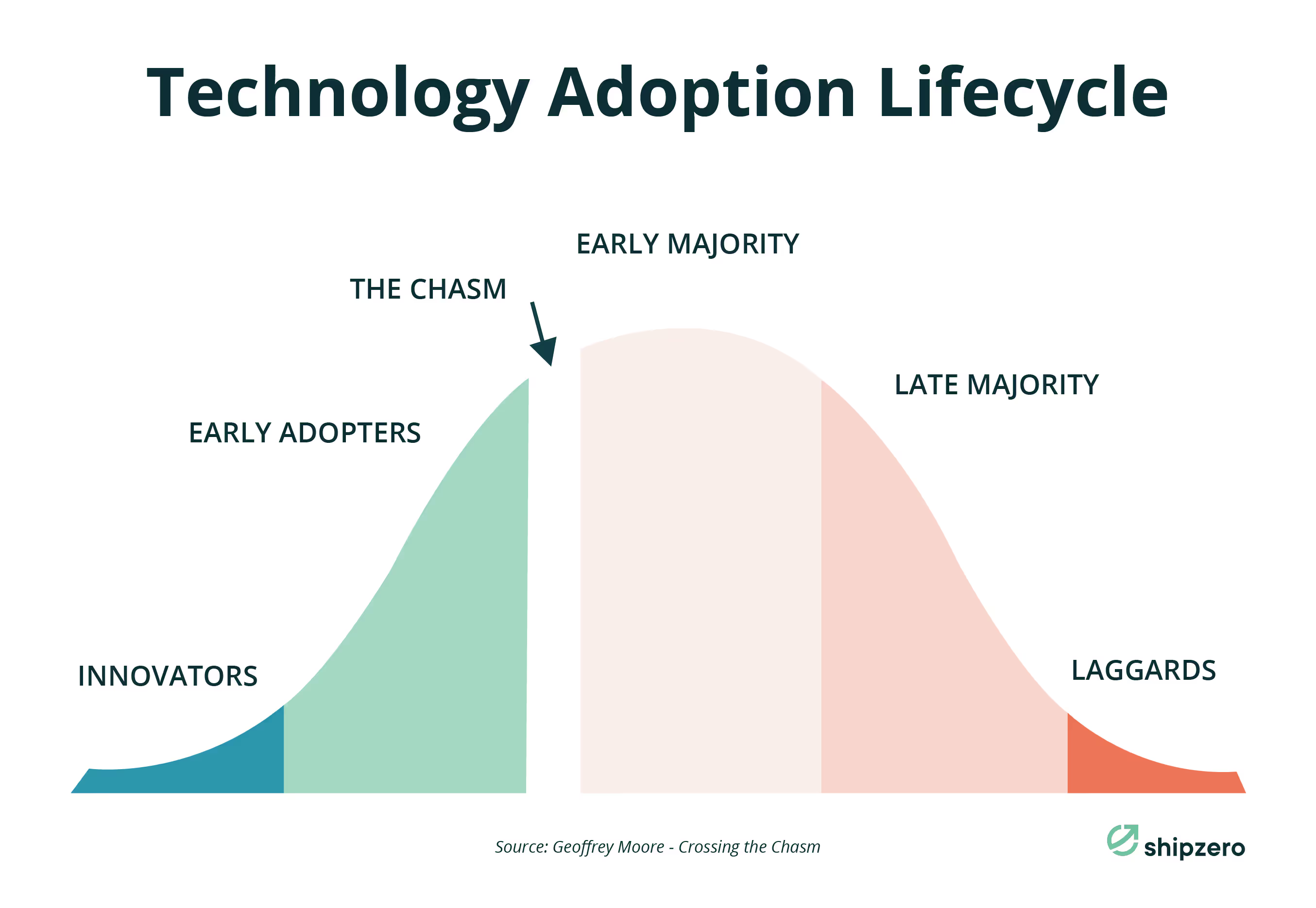
The process of the so-called "Technology Adoption Lifecycle" can be well described using the example of e-mobility: Innovators and early adopters had to shoulder high acquisition costs for individual vehicles a few years ago, test them in live operations, and at that time searched in vain for functional charging stations. Meanwhile, vehicle manufacturers are going into series production with electric models, many teething problems of the technology have been eliminated, and the charging infrastructure is being expanded.
Now it's time to seize opportunities: Currently, we are in the so-called "Chasm" – the gap before innovative technology becomes commonplace. Logistics companies that now rely on electrified transport can secure competitive advantages before the topic reaches the mainstream, loses its unique selling potential, and ultimately becomes the standard.
Because: According to a study by the consulting firm PwC, electric trucks will displace diesel vehicles starting in 2030. The range on a single battery charge will increase to 900 kilometers by then, and charging speed is expected to triple. The economic advantage of e-mobility is foreseeable.
Even today, electric trucks are economically competitive, especially for long-distance routes. The often still high leasing rates are offset by significantly lower consumption costs.
Another important driver: The perspective of cargo owners is changing dramatically. While according to the BVL study, currently only six percent consider sustainability in logistics a priority topic, almost three-quarters want to focus more heavily on it in the next five years – a paradigm shift that will electrify the entire industry.
We are at the point where sustainable logistics is no longer just ethically but also economically worthwhile. Those who don't act now will lose their connection.
Biofuels and Book & Claim: Pragmatic Solutions for Immediate Use
Biofuels like HVO100 (Hydrotreated Vegetable Oil) offer significant potential for reducing greenhouse gas emissions and can be integrated into existing fleets. Particularly promising is Book & Claim, which enables the flexible use of sustainable transport options without major investments. Companies can "book" sustainable transport services even if they are not physically provided in their own supply chain.
For freight forwarders and logistics service providers, Book & Claim offers direct financial relief: The proceeds from selling emission credits flow back to the company and help refinance transformation costs. Companies like Airbus, Dow, FedEx, DHL, and IKEA invest strategically from decarbonization budgets due to the high transparency and traceability of the measures. This is completely new business potential compared to previous models through compensation projects, which were typically made available to transport purchasers as additional costs.
It's not about the perfect green transport system of tomorrow, but about continuous improvements today, such as better utilization and optimized routes. Every ton of CO2 saved counts.
Why Precise Data is Essential
Logistics companies and cargo owners need transparent, comparable CO2e emission data. They have become an important selection criterion in tenders, audits, and partnerships. Request for proposals from cargo owners require increased detail, often broken down by transport routes, modes of transport, and subcontractors. Since transport buyers increasingly compare providers based on their CO2 footprint, emission data has a direct impact on business relationships.
With a robust data management system and standardized, repeatable processes, logistics companies gain strategic insights and make more informed business decisions based on the highest possible data quality. A centralized emissions management platform can automatically retrieve transport data from a variety of systems and harmonize and enrich it for CO2 calculations. Based on an accredited methodology for emission calculation according to international frameworks (GLEC) and standards (ISO 14083), logistics companies can confidently respond to customer inquiries and send individual CO2 emission reports with just a few clicks.
Conclusion
The decarbonization of logistics offers significant benefits. Data-driven optimization of transport represents a crucial – and proven – lever to save costs and CO2 by maximizing utilization and minimizing empty runs. Where the use of electrified vehicles is not yet feasible, HVO100 as an alternative fuel can generate additional significant savings without retrofitting.
Logistics companies acting pragmatically in this way can also secure decisive competitive advantages without bearing the financial risk of the pioneers. We are not at the beginning of a transformation, but in the middle of it. The question is no longer whether logistics will be decarbonized. But who will be ahead and profit economically.
To learn how your company should act at the chasm stage, please get in touch with one of our industry experts.
If you want to dive deeper into Book & Claim, you can download our white paper for logistics companies (in English or German) or about gaining competitive advantages through Book & Claim.


Related articles