

Reducing CO₂e emissions as an integral part of the corporate strategy
RINNEN partnered with shipzero to address data gaps and standardize carbon emissions calculations across its chemical transport operations. This enabled the company to accurately measure emissions and use those insights to drive reductions across its logistics footprint.
Summary
RINNEN needed reliable data on its CO2 footprint to build an effective climate protection strategy. The logistics company faced increasing demand from cargo owners for transport emissions data due to CSRD reporting obligations, while the generation of emissions reports was complex and difficult to manage internally. Additionally, proof of verifiable CO2 measurement was increasingly required for tenders and SQAS audits.
By partnering with shipzero, RINNEN integrated order data from its transport management system and primary data from fleet telematics, achieving over 98% data processing accuracy. The company now calculates Scope 1 emissions using fuel consumption data and Scope 3 emissions from external service providers, all according to GLEC standards. RINNEN can automatically create multimodal emissions reports with diverse filter dimensions, successfully using scenario analysis for tenders to win new business by providing emission values alongside pricing.
RINNEN uses shipzero to:
· Calculate GLEC-accredited multimodal transport emissions (Scope 1, 3) at a precise level using primary data from fleet telematics, achieving over 98% data processing accuracy
· Automate emissions report generation with one click for customer inquiries, tenders, and SQAS audits with numerous filter dimensions and standardized shipment-level exports
· Manage comprehensive data exchange via interfaces to telematics and transport management systems, with automated data clarification processes ensuring highest quality
· Conduct scenario analysis for tenders to provide emission values for potential transports, supporting new business acquisition and climate-efficient transport goals


RINNEN needed reliable CO2 footprint data to support its sustainability strategy, while facing increasing demand for automated emissions reports at shipment level for CSRD reporting, tenders, and SQAS audits.

shipzero integrated RINNEN's TMS order data and fleet telematics primary data, enabling GLEC-accredited Scope 1 and 3 emissions calculations with automated reporting and scenario analysis capabilities for tenders.
Challenge: Establishing reliable emissions data for corporate strategy and compliance
RINNEN supports the United Nations' Sustainable Development Goals (SDG) and has anchored sustainable action and management as an integral part of its corporate strategy. However, the basis for an effective climate protection strategy is the calculation of the company's own CO2 emissions (Scope 1) and a precise understanding of the various sources of emissions. It was therefore RINNEN's aim to obtain reliable and valid data on its own CO2 footprint with the help of an external partner.
Due to increasing CSRD reporting obligations on the part of cargo owners, RINNEN noticed an increasing demand for transport emissions data. The generation of emissions reports was a complex process that was difficult to manage internally. It was also challenging to map the emissions of individual transport legs for intermodal transports.
Furthermore, proof of verifiable CO2 measurement and evaluation was increasingly being used as a criterion for tenders. As one of the leading chemical logistics companies and a member of the ECTA Responsible Care Program, RINNEN is obliged to submit to the SQAS audit (Safety and Quality Assessment for Sustainability). The challenge was to consider upstream and downstream emission values in addition to the directly emitted CO2 emissions.
Solution: Comprehensive data integration and GLEC-accredited emissions calculation
First, an interface was created for secure data transfer. This makes it possible to integrate the order data from the transport management system (TMS) into the shipzero data platform. The primary data from the Spedion fleet telematics system was also transferred and merged with the order data from the TMS. This allows transports to be assigned to the corresponding customers and orders.
The data is reviewed for errors and plausibility with each monthly transmission (data clarification process), which enables high data quality before the emissions calculation. Input errors such as excessive weights can thus be detected and adjusted.
RINNEN uses the fuel consumption data from its own fleet to calculate Scope 1 emissions, which is the most accurate method of calculating transport emissions. Scope 3 emissions are measured using order data from external service providers in road and rail transport. In general, CO2 emissions in RINNEN's intermodal supply chains are calculated according to the highest standards of the GLEC framework.
Through using shipzero, RINNEN is able to automatically create a multimodal tracking of greenhouse gas emissions. The filter dimensions for reporting are diverse and have been expanded at RINNEN's request.
“We are able to classify the total CO2 value into different categories, i.e., well-to-tank and tank-to-wheel. This allows us to say: The direct emission value of a transport is the value X. However, in order to fully evaluate the emissions, the upstream or downstream activities must also be included in the calculation.”
Results: Automated reporting and new business through scenario analysis
RINNEN is able to automatically create multimodal emissions reports with diverse filter dimensions. The chemical logistics company can filter and analyze its emissions data according to individual requirements. The data can be processed and viewed in the data platform or downloaded as an Excel file. This enables simple and automated export of emissions reports for customer inquiries, tenders or audits and assessments.
RINNEN also uses shipzero's expertise for tenders and to acquire new business. In a first joint project, a scenario analysis for selected transports was conducted. In line with GLEC, this involved determining the emissions that would be generated by potential transports. The forecast was very well received by clients, enabling RINNEN to indicate CO2 emissions alongside pricing and supporting their goals of conducting transports as climate-efficiently as possible.
“As part of a tender, we were able to provide emission values for the potential transports. shipzero has calculated the emissions data that we anticipate for certain lanes. This was previously not possible for us and enabled us to indicate the CO2 emissions as well as the price. This was very well received by the potential customer and supports our goals of conducting transports as climate-efficiently as possible. shipzero was able to support us competently and at short notice. This was a first success story that we were able to realize right at the beginning of our cooperation.”
Outlook: Expanding to logistics sites and holistic emissions management
The first major step has been taken: RINNEN has established transparency regarding the transport emissions of its European and multimodal logistics network. The calculation of the CO2 emissions emitted by its own fleet is even based on primary consumption data. The granular database makes it possible to identify potential CO2 savings in the supply chain and derive measures to reduce them. The foundation for future decarbonization projects has thus been laid: Effective reduction potentials can be determined based on data.
RINNEN is also planning to connect its logistics sites to the shipzero data platform for holistic emissions management. In addition to transport emissions, this will also include emissions from warehouses and transshipment sites, a requirement of ISO 14083 published in March 2023. Tank cleaning processes will also be measured and quantified as part of this process.
Learn more about how shipzero's Client & Audit Reporting and Data Ingestion solutions work for logistics service providers in the chemicals industry.
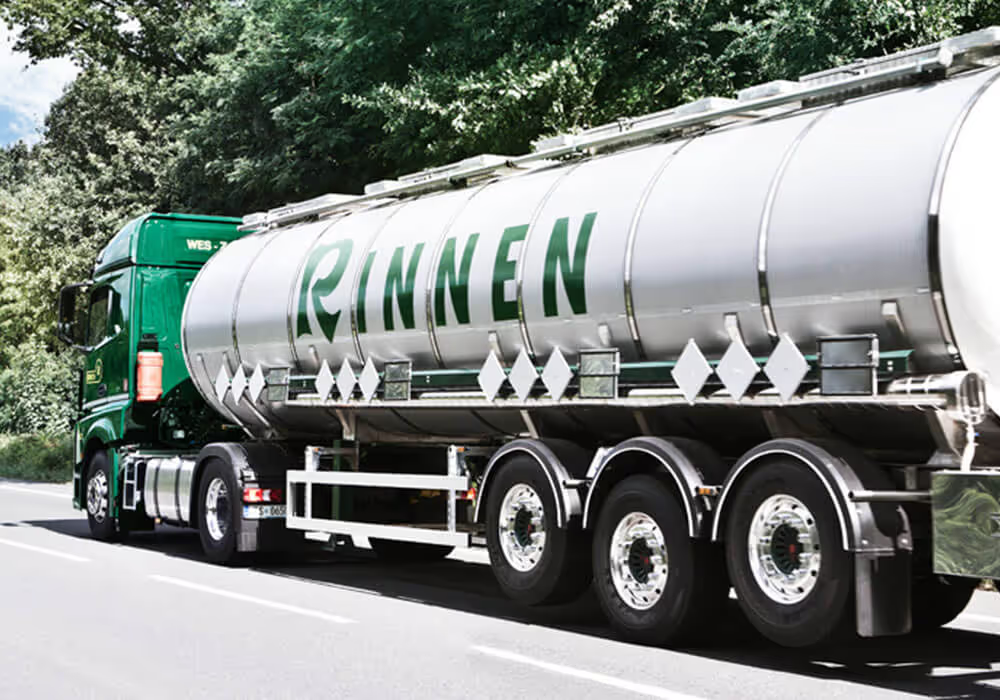
RINNEN GmbH und Co. KG is one of the leading logistics providers in the field of liquid and hazardous goods transportation in Europe. Based in North Rhine-Westphalia, the company operates eleven locations in Germany and Europe. RINNEN's core competencies lie in the handling of dangerous goods and intermodal transportation. RINNEN's main mode of transport is road, but intermodal handling with rail and short sea is growing disproportionately.
Around 150,000 transports are carried out across Europe every year, primarily liquid chemical transports in tank containers and tank trailers. Around 4,000 tank containers are in use at RINNEN. Tank trailers are used particularly in regions where intermodal transport is not yet developed. RINNEN owns around 350 tank trailers and several special jumbo trailers. RINNEN's logistics locations include garages, storage facilities and, in some cases, cleaning systems. Over 9,000 different chemical products can be processed in the tank cleaning facilities.


Read similar stories

How Bruhn Used SQAS to Build Emissions Management on Data It Already Had
Calculating Shipment-Level Emissions Across a Complex Groupage Network
.jpg)