

How Lanfer Mastered a Demanding SQAS Audit in Record Time
Lanfer Logistik had only a few months to prepare for a complex SQAS audit, which required measuring emissions from tank cleaning and tank heating as well, and set a much higher bar for primary data. Working with shipzero to interpret the new requirements under huge time constraints, Lanfer passed the audit with a score above 92% and left a strong enough impression that the auditor began thinking about what that could mean for how future audits are run.
Summary
Lanfer Logistik, a third-generation family-owned specialist in liquid and chemical logistics, has worked with shipzero since 2021 to calculate transport emissions across its own fleet and integrated partners. When the 2025 edition of the SQAS questionnaire (the Safety and Quality Assessment System used across the chemical industry) expanded its CO₂ accounting section from around ten questions to nearly sixty, the scope of what needed to be measured changed fundamentally. For the first time, Lanfer had to account for tank cleaning, tank heating, and other hub operations as distinct emission sources, alongside classic transport emissions, and reconcile the SQAS catalogue with the ISO 14083 standard and the GLEC Framework.
With only a few months between the finalized questionnaire and the audit date, Lanfer and shipzero worked closely together to interpret the new SQAS requirements, while shipzero connected additional data sources (including cleaning and billing systems) and supplemented the remaining gaps with its existing secondary data.
Lanfer uses shipzero to:
• Calculate GLEC- and ISO 14083-aligned transport emissions across a trimodal network (road, rail, and inland waterway), spanning its own fleet, integrated partners, and subcontractors
• Measure previously uncounted hub operations – tank cleaning and tank heating – as distinct emission sources required by the SQAS 2025 questionnaire
• Trace and calculate empty runs as proper transport legs, matching each one back to its originating order – even where Lanfer's own data had no direct link between the two
• Consolidate data from its TMS, telematics, and cleaning/billing systems into a single audit-ready platform, drawing on shipzero's secondary data where primary data isn't available (e.g. from rail and water carriers)
• Respond to growing customer and tender requests for lane-level CO₂ data with confidence, backed by a SQAS score above its target


Lanfer had worked with shipzero on transport emissions since 2021, but the rewritten 2025 SQAS questionnaire required six times as many CO₂-related answers, including entirely new categories like tank cleaning and tank heating, with only a few months' notice before the audit.

shipzero and Lanfer worked closely together to interpret the new SQAS requirements for hub operations, connected additional data sources, and filled remaining data gaps with shipzero's existing secondary data needed to score confidently against the expanded catalogue.
Challenge: A Rewritten Standard, With Only Months to Prepare
Lanfer Logistik has worked with shipzero since 2021 to calculate the CO₂e emissions of its transport operations, initially focused on its own fleet and integrated transport partners. SQAS audits were nothing new to Lanfer either: as a chemical logistics provider, the company undergoes the Safety and Quality Assessment System audit every three years, and CO₂e accounting had already been part of the questionnaire in previous cycles.
What changed with the 2025 edition was the depth and scope of that requirement. Lanfer's audit cycle means the company is typically among the first to work with a newly revised SQAS questionnaire – a preliminary indication of direction becomes available mid-year, with the finalized version following only shortly before the audit itself, which for Lanfer falls in February or March. The full SQAS transport-sector questionnaire runs to around 660 questions, plus roughly 200 core company questions and a separate set for cleaning operations. Of these, the CO₂e accounting section alone grew from around ten questions to nearly sixty – a jump that, on its own, illustrates the scale of the shift.
For the first time, the questionnaire required Lanfer to measure emissions from what SQAS terms “Hub Operations” – tank cleaning, tank heating as well as the empty runs associated with them – categories that had never been part of a transport-only emissions calculation before. Reconciling these new requirements with the ISO 14083 standard and the GLEC Framework added a further layer of complexity, since the three frameworks were not always perfectly aligned – for example, in how empty running “on behalf of a customer” should be defined and attributed, or in the vehicle and train type classifications SQAS itself uses, which differ from Lanfer and shipzero's standard categories. On top of the methodology itself, the questionnaire placed a much stronger emphasis on primary data over secondary or default values, which meant Lanfer needed to secure verifiable operational data wherever possible, including from its subcontractors.
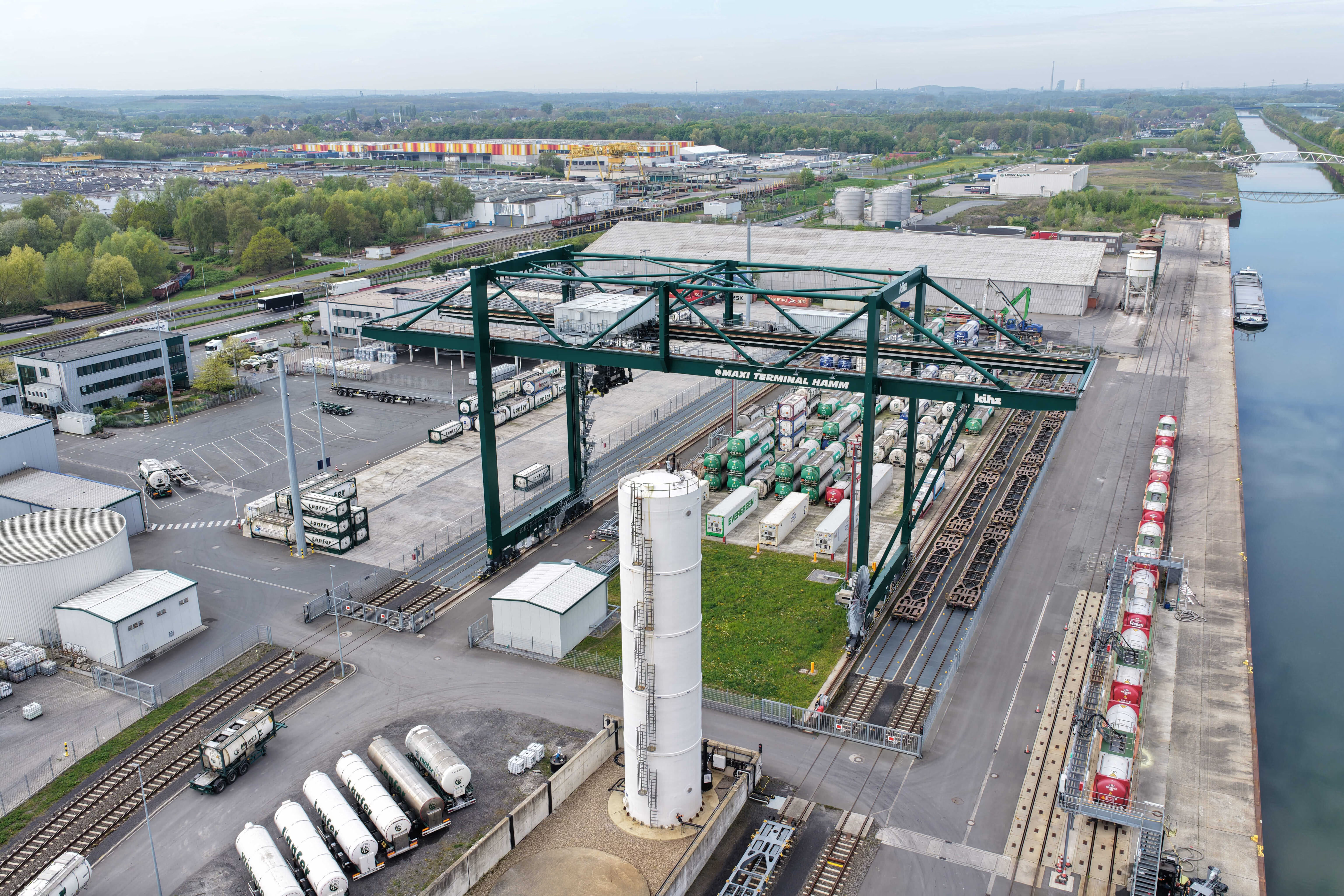
The complexity was compounded by Lanfer's network itself: a trimodal operation spanning road, rail, and inland waterway, processing around 200,000 transport orders per year that split into roughly one million individual transport and process steps once trimodal legs and value-added services are accounted for. Some of this network runs through Lanfer's own fleet and dispatch systems; other parts run through integrated partners and subcontractors with varying levels of system access, each of which needed to supply its own CO₂ data. And SQAS was only one of several audits running in parallel – Lanfer's Head of HSEQ, André de Bruyn, spent 21 days on-site with auditors across the company's various locations for SQAS: 2025, ISO 9001 and HACCP certifications during the same period.
"Previously, the CO₂e accounting section of the SQAS questionnaire had around ten questions. In the new version, there were sixty."
Solution: Interpreting the New Requirements, Connecting the Missing Data
Given Lanfer's long-standing relationship with shipzero, the decision to bring the leading emissions intelligence platform into the SQAS preparation was immediate. No alternative providers or external consultants were considered. shipzero was upfront that several of the new SQAS requirements, particularly around hub operations, were new territory for the platform as well, but committed to working through the open interpretation questions with Lanfer and building the necessary calculation logic within the available timeframe, while keeping the methodology itself independently developed and applied by shipzero.
The first task was a conceptual one: before any data could be modeled, Lanfer and shipzero needed to jointly define what actually constitutes a distinct Transport Operation Category (TOC) or Hub Operating Category (HOC) for Lanfer's business. This was an abstract exercise with a very concrete goal, since defining too many categories would have added unnecessary complexity without improving the audit outcome.
On the data side, the project required linking Lanfer's transport management system, its telematics platform, and its tank-cleaning and billing system into a single, consistent dataset. Some of the required data such as tank heating hours had been recorded, but not been assigned to the transport order, since the need for it had not been identified until the third quarter of 2025. This meant partially reconstructing historical data from invoices and manual records rather than starting to track it only going forward. Wherever Lanfer or its partners could not supply reliable primary data – most notably for subcontractors – shipzero's existing secondary data provided a credible, audit-ready fallback, sparing Lanfer from having to research suitable default values from scratch.
Empty runs presented a particular challenge of their own: SQAS requires every empty run to be matched back to the order it relates to, but Lanfer's own data contained no direct link between the two. Lanfer and shipzero worked together to build a tracing logic that could reconstruct this connection retroactively, so that each empty run could be assigned to its originating order.
Underpinning all of this was documentation: every assumption and methodological decision – from the reconstruction of data to when and why secondary data was used instead of primary data – was recorded by shipzero in a form the auditor could trace directly within the platform, rather than having to take Lanfer's word for it.
To manage the tight schedule (active work began in October 2025, with submission due by the end of February 2026), shipzero provided a structured implementation plan that gave the cross-functional project team, including Lanfer's IT and dispatch departments alongside HSEQ, clear orientation for prioritizing the many open work packages. Lanfer highlighted shipzero team's persistence as a key factor in staying on schedule: outstanding data requests were followed up on consistently rather than left open, which proved essential given how many competing priorities were in motion internally at the same time.
"I'm very grateful that shipzero put together such a structured implementation plan for our SQAS audit. They supported us brilliantly there – we could never have managed that timeline on our own."
Results: A Passing Score and a Possible New Standard for Future Audits
The SQAS audit itself is evidence-based and conducted on-site: rather than assembling separate folders of documentation for each data source, Lanfer's auditor was able to query any customer or lane directly within the shipzero platform and see the documented reasoning behind each figure. Lanfer passed the audit at a score above its internal target; a result achieved despite the substantially higher bar set by the new questionnaire.
Part of what made the audit go smoothly was Lanfer's own transparency: rather than claiming full compliance across the board, the company proactively flagged the areas where it knew gaps remained – for instance, where subcontractor data still relied on secondary values rather than primary data – and asked the auditor not to credit those specific answers. Every measure Lanfer did claim as fully implemented held up to verification, with no discrepancies found.
The auditor's review extended to shipzero itself: he examined shipzero's certifications and public documentation to assess the credibility of the underlying methodology, and came away sufficiently convinced that he raised – as a personal view, not yet an adopted policy – the idea that future audits could apply a lighter review to companies working with adequately certified and qualified emissions platforms, rather than independently re-verifying every methodological detail from the ground up each cycle. For an auditor Lanfer describes as notably measured and dispassionate, the remark stood out as an unusually strong endorsement.
On the numbers: the emissions calculation now covers around 200,000 transport orders per year, split into roughly one million individual transport and process steps once trimodal legs and value-added services are factored in, totaling approximately 68,000 tonnes of CO₂e annually. A substantial share of this is based on primary data from Lanfer's own fleet of 500 tractor units, densely connected via telematics. Emissions from Lanfer's four main sites, five secondary sites, and its international locations in Belgium, Spain, and Italy – calculated internally rather than through the shipzero platform – were merged into the same overall picture to give a complete view of the company's transport-related footprint.
The impact has extended well beyond the audit itself. Lanfer's customer service team now fields significantly more requests for lane-level emissions data, which is increasingly becoming a requirement in tenders rather than a nice-to-have. Lanfer can now respond with confidence. Internally, analyses that used to require considerable manual effort are now routine, and access to the shipzero platform is being extended to more customer-facing staff, since it does not require expert-level training to use.
"We are transporters in the chemical industry, and we have to guarantee a maximum level of quality. Our aim is to score a very good ranking, and we managed to achieve that again this time."
Outlook: From Compliance Exercise to Strategic Asset
What began as a response to a specific audit requirement has increasingly become a broader asset for Lanfer. The underlying emissions data now supports customer inquiries, tender responses, and Lanfer's own efforts to identify reduction potential across its transport network, moving the project from a compliance exercise toward a more permanent part of the company's sustainability strategy.
Looking ahead, Lanfer's priorities include continuing the shift from secondary to primary data, particularly with subcontractors, and further automating its data connections to move from quarterly to monthly reporting cycles. The next SQAS cycle, expected in 2028, is already on Lanfer's radar: the auditor hinted that the next questionnaire may contain fewer questions overall – a change that, if it materializes, would make each individual answer carry correspondingly more weight.
Reflecting on the project, André de Bruyn's advice to other companies facing a similar overhaul is to build in a much more generous timeline wherever possible, and not to underestimate the scope of the undertaking, particularly the work of consolidating data from multiple systems and the exercise of defining one's own relevant Transport and Hub Operating Categories from scratch, since it's easy to define far more categories than ultimately turn out to matter.
"In the long run, we want to keep expanding our CO2 reporting, and we'd like to keep doing that together with shipzero, because we see great potential there. Carbon accounting and reduction measures in particular are only going to become more relevant."
Learn more about how shipzero's Client & Audit Reporting and Data Ingestion solutions work for logistics service providers in the chemicals industry.
Lanfer Logistik is a third-generation, family-owned specialist in liquid and chemical logistics based in Meppen, Germany, with a history spanning almost 100 years. The company employs around 1,000 people and operates a fleet of more than 600 tractor units, 1,100 tank trailers, and 8,500 tank containers, serving the chemical, mineral oil, and food industries. Lanfer runs a trimodal network across road, rail, and inland waterway transport, with main and secondary sites across Germany and additional locations in Belgium, Spain, and Italy.


Read similar stories

How Bruhn Used SQAS to Build Emissions Management on Data It Already Had
Calculating Shipment-Level Emissions Across a Complex Groupage Network
.jpg)