Smart Freight Week 2026 at a glance
Smart Freight Week 2026 took place in Amsterdam in April 2026 and brought together about 1,000 participants. Despite mounting pressure on sustainability agendas, such as regulatory rollbacks (CSRD Omnibus), macroeconomic headwinds and shrinking budgets, the conference delivered a surprisingly optimistic signal: the green logistics ecosystem is maturing, becoming more commercial and converging on clearer technology pathways.
The event revealed an industry that is simultaneously more mature and more patient than headlines might suggest. The shift from concept to commercialization is real and healthy. This summary reflects the discussions and timelines as presented at the conference in April 2026.
Planned framework updates
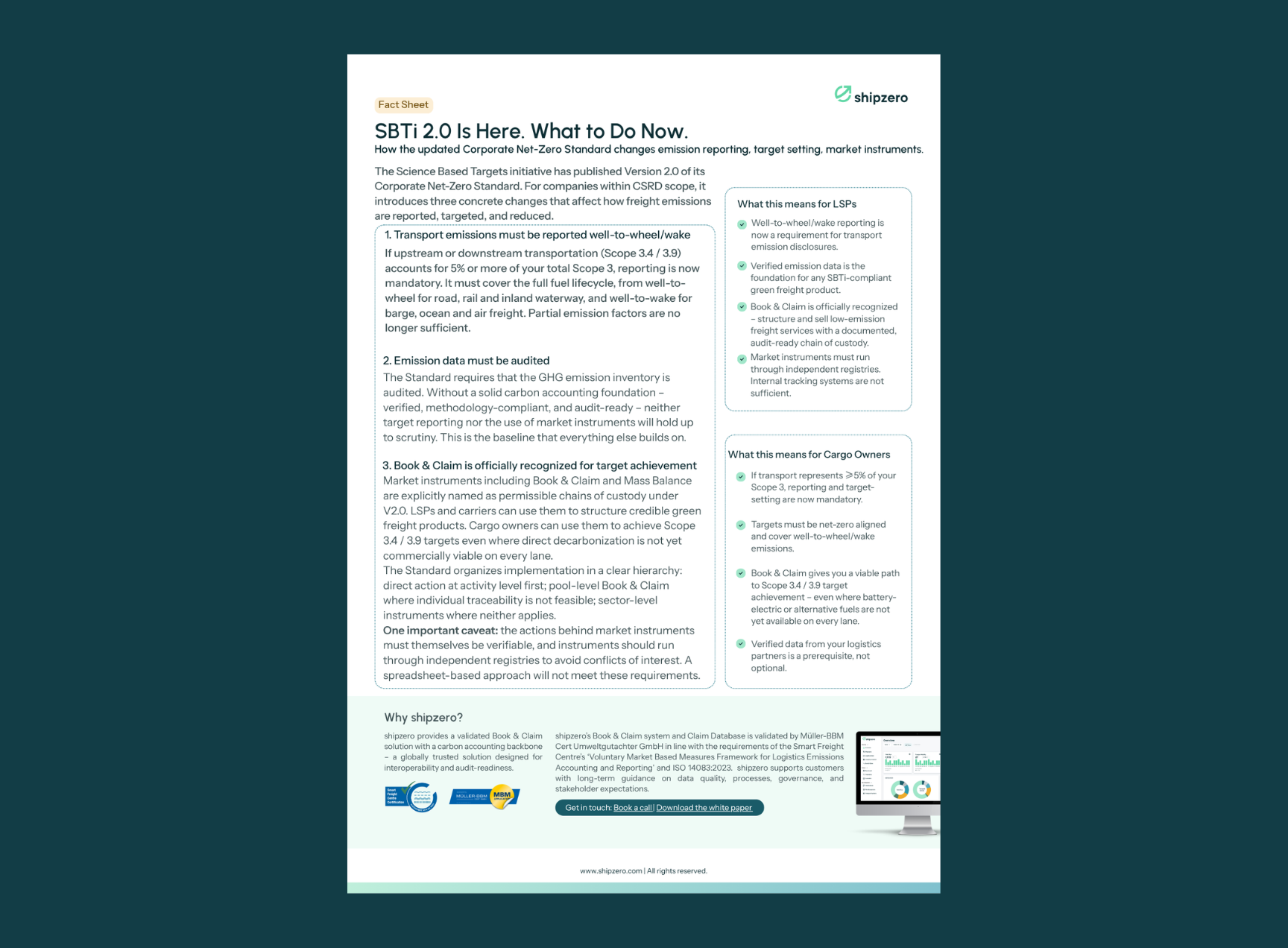
- SBTi: directional guidance on market-based measures, expected in June 2026
- Smart Freight Centre: revision of the MBM Framework, expected in early 2027
- GHG Protocol: update (AMI), expected in late 2028
1. Market-based measures (MBMs): progress in theory, patience in practice
Market-based measures (MBMs) moved from concept to pilot stage, testing how book-and-claim instruments can channel investment toward decarbonization. Yet uncertainty persists: biofuel prices remain coupled to fossil fuels, and investments are inherently transactional, so no lasting infrastructure is built. Their primary value is signaling demand to scale the production of sustainable aviation fuel (SAF) and alternative marine fuels. European regulations (ETS, FuelEU Maritime, ReFuelEU Aviation) provide a regulatory floor, while voluntary markets lag.
The Science Based Targets initiative (SBTi) was expected to release directional guidance on MBMs in June/July 2026. A codified standard is not expected before late 2028, which creates a strategic tension between the need for clarity now and governance that is two-plus years away. A key next step is the Smart Freight Centre's revised MBM Framework, due in early 2027, which is to be harmonized with ISO 22095 chain-of-custody norms.
2. Road freight electrification: a clear winner is emerging
Battery electric vehicles (BEVs) were affirmed at the conference as the definitive pathway for road freight, with exceptions limited to specific geographies and extreme conditions. The energy cost crossover is already visible, even without incentives. Full superiority is years away, not decades. Staying focused on BEVs, rather than chasing alternative propulsion narratives, was a clear conference consensus.
Remaining barriers:
- Charging infrastructure rollout
- Upfront CapEx premiums
- Green electricity certification and data traceability
3. Data standardization: the overlooked bottleneck
The challenge: The GLEC Framework and ISO 14083 set the accounting backbone for logistics emissions, yet divergent databases produce materially different results across emission factors, vehicle classes and fuel types.
The solution: Invest in consistent global master data: harmonized emission factors, standardized taxonomies and location-based reference data.
The result: According to the conference discussions, this foundational data layer reduces variance between calculation models more effectively than any further methodological refinement.
4. Green procurement: from pilot projects to scalable markets
Green procurement remains pre-scale. About 80% of freight transactions are cost-driven and transactional, and pilots prove concepts but rarely exceed single-digit market share. The path to scale is economic, not idealistic: green options must compete on cost, and the energy cost crossover is the real unlock. Microsoft's SAF deal (about 100,000 tCO₂e abated) signals ambition but remains an exception.
The critical enabler: buyer-supplier alignment
- Procurement sends consistent demand signals.
- Logistics providers respond with validated, commercially attractive solutions.
Until this handshake happens at scale, green freight remains a niche.
Strategic outlook: 5 key takeaways for sustainability leaders
- Monitor the SBTi / GHG Protocol timeline closely, but do not wait for it to act. The summer 2026 directional statement will shape strategy, while final standards are expected in late 2028.
- Double down on road freight electrification. The technology path is settled. Focus on securing green energy supply, charging infrastructure partnerships and optimizing CapEx.
- Send demand signals into the market for SAF, renewable marine fuels and green electricity to accelerate the supply-side build-out that enables scalable decarbonization.
- Invest in data foundations over methodological refinement. Harmonized master data (emission factors, vehicle taxonomies, location data) will reduce variance and build trust faster than additional guidance layers.
- Align procurement organizations and collaborative processes. The energy cost crossover is approaching. Prepare transactional procurement models that integrate sustainability KPIs for the moment green options reach cost parity.
Key terms explained
- MBM (market-based measures): instruments, such as book and claim, that channel funding toward decarbonization without the low-carbon fuel having to be used in the buyer's own shipment.
- BEV (battery electric vehicle): a vehicle powered by a battery and an electric motor, without a combustion engine.
- SAF (sustainable aviation fuel): a lower-carbon alternative to fossil jet fuel.
- ETS, FuelEU Maritime, ReFuelEU Aviation: European regulations that put a price on emissions or set requirements for lower-carbon fuels in shipping and aviation.
- SBTi (Science Based Targets initiative): the organization that validates corporate climate targets and develops related standards.
- GHG Protocol: the most widely used set of standards for corporate greenhouse gas accounting. AMI stands for Actions and Market Instruments.
- ISO 22095: an international standard on chain of custody.
- Energy cost crossover: the point at which operating on electricity becomes cheaper than operating on conventional fuels.
- Master data: standardized reference data, such as emission factors, vehicle classes and location data, that emissions calculations rely on.
- CapEx: capital expenditure, the upfront investment in assets such as vehicles or charging infrastructure.
- CSRD Omnibus: the EU initiative to simplify and scale back sustainability reporting rules, including the CSRD.