SBTi Version 2.0: what changes for freight emissions
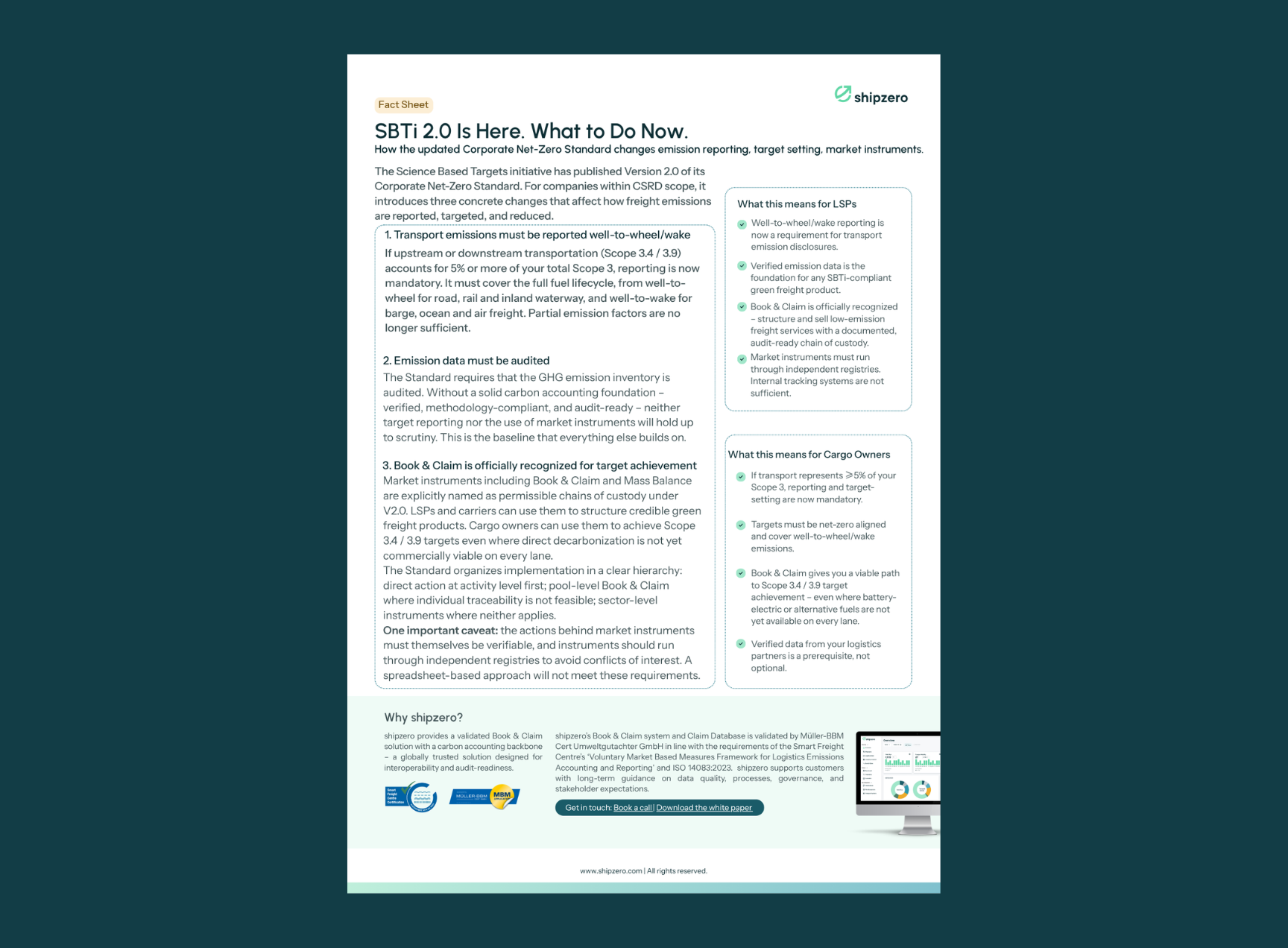
The Science Based Targets initiative (SBTi) has published Version 2.0 of its Corporate Net-Zero Standard in June 2026. For companies that set or validate targets with the SBTi, it introduces three concrete changes that affect how freight emissions are reported, targeted and reduced.
According to current SBTi information, validation under Version 2.0 is expected to begin in February 2027, and companies can continue to submit under the previous versions until 31 January 2028.
1. Transport emissions must be reported well-to-wheel/wake
If upstream or downstream transportation and distribution (Scope 3 categories 3.4 and 3.9) accounts for 5% or more of your total Scope 3 emissions, reporting is required under Version 2.0. It must cover the full fuel lifecycle: well-to-wheel for road and rail, and well-to-wake for inland waterway, ocean and air freight. Partial emission factors are no longer sufficient.
2. Emission data must be audited
The Standard requires that the greenhouse gas (GHG) emission inventory is audited. Without a solid carbon accounting foundation that is verified, methodology-compliant and audit-ready, neither target reporting nor the use of market instruments will hold up to scrutiny. This is the baseline that everything else builds on.
3. Book & Claim is recognized for target achievement
Market instruments, including Book & Claim and Mass Balance, are explicitly named as permissible chains of custody under Version 2.0. Logistics service providers (LSPs) and carriers can use them to structure credible green freight products. Cargo owners can use them to achieve Scope 3.4 and 3.9 targets, even where direct decarbonization is not yet commercially viable on every lane.
The implementation hierarchy
The Standard organizes implementation in a clear order:
- Direct action at activity level comes first.
- Pool-level Book & Claim applies where individual traceability is not feasible.
- Sector-level instruments apply where neither of the above is possible.
An important caveat
The actions behind market instruments must themselves be verifiable, and instruments should run through independent registries to avoid conflicts of interest. A spreadsheet-based approach is unlikely to meet these requirements.
What this means for LSPs
- Verified emission data is the foundation for any green freight product that is used toward SBTi targets.
- Book & Claim is recognized: structure and sell low-emission freight services with a documented, audit-ready chain of custody.
- Transport emission reporting under Version 2.0 covers well-to-wheel/wake emissions.
- Market instruments must run through independent registries. Internal tracking systems are not sufficient.
What this means for cargo owners
- If transport represents 5% or more of your Scope 3 emissions, reporting and target-setting are required under Version 2.0.
- Targets must be net-zero aligned and cover well-to-wheel/wake emissions.
- Book & Claim gives you a viable path to Scope 3.4 and 3.9 target achievement, even where battery-electric or alternative fuels are not yet available on every lane.
- Verified data from your logistics partners is a prerequisite, not optional.
This fact sheet summarizes key changes for freight and logistics. It does not replace the official SBTi Corporate Net-Zero Standard.
Key terms explained
- SBTi (Science Based Targets initiative): the organization that validates corporate climate targets and develops the related standards.
- Corporate Net-Zero Standard: the SBTi framework for setting, implementing and reporting net-zero targets.
- Scope 3.4 and 3.9: Scope 3 categories for upstream and downstream transportation and distribution, which include purchased freight.
- Well-to-wheel/wake: the full fuel lifecycle, from fuel production to use. "Wheel" applies to road and rail, "wake" to waterborne and air transport.
- Book & Claim: a chain-of-custody model that separates the environmental benefit of a low-carbon fuel or service from its physical use, so it can be assigned to a buyer through a registry.
- Mass balance: a chain-of-custody model that tracks sustainable and conventional material in a shared system and allocates the sustainable share through bookkeeping.
- Chain of custody: the documented tracking of a product or claim along the supply chain.
- Pool-level and sector-level instruments: market instruments that operate across a group of actors or a whole sector, used where activity-level traceability is not possible.
- Independent registry: a third-party system that records claims and prevents double counting.
- LSP (logistics service provider): a company that manages or executes transport services.