Why decarbonization ROI matters in logistics procurement
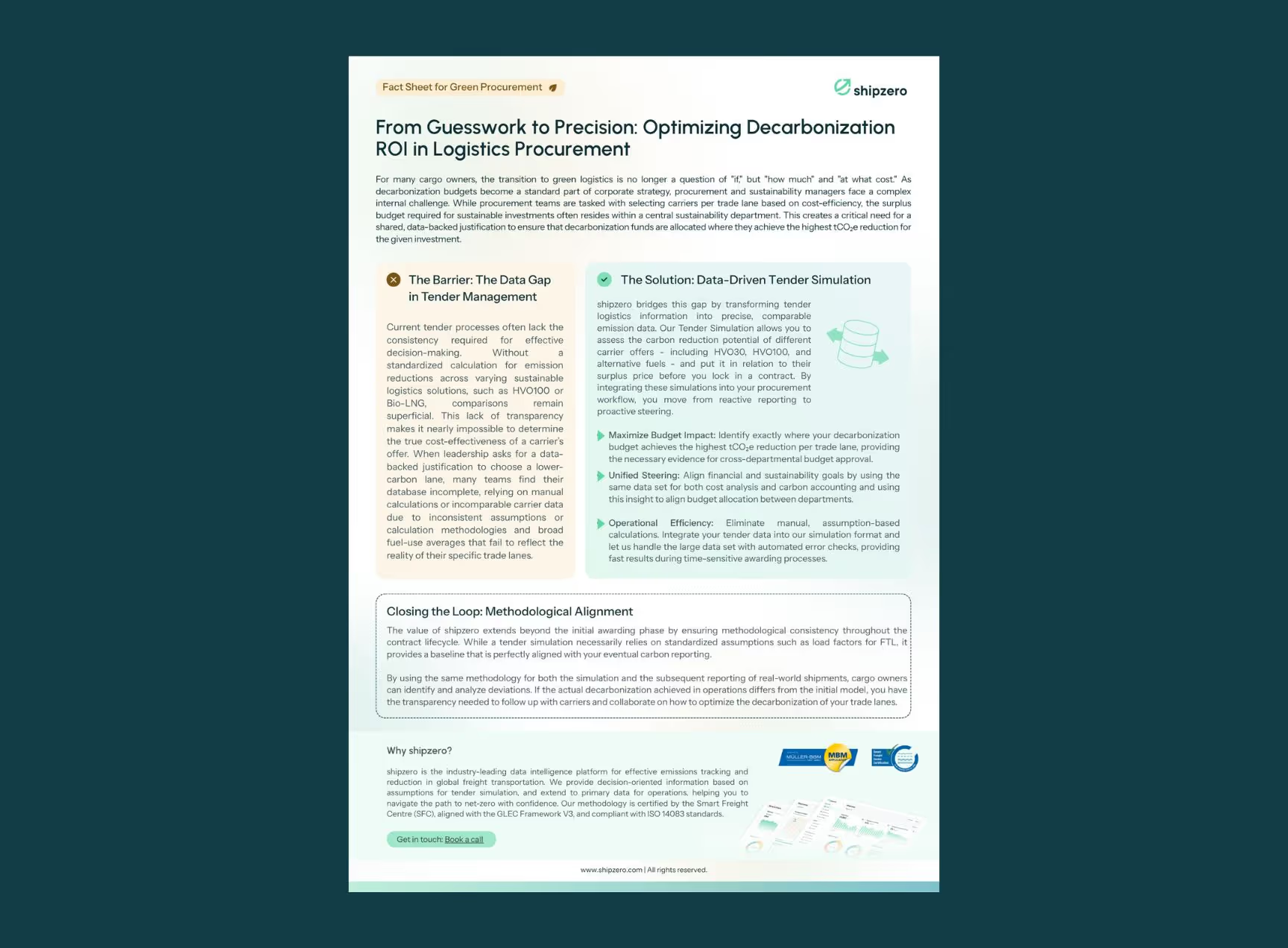
For many cargo owners and logistics service providers (LSPs), the transition to green logistics is no longer a question of "if", but of "how much" and "at what cost". As decarbonization budgets become a standard part of corporate strategy, procurement and sustainability managers face a complex internal challenge.
Procurement teams select carriers per trade lane based on cost-efficiency, while the surplus budget for sustainable investments often sits in a central sustainability department. This creates a need for a shared, data-backed justification that ensures decarbonization funds are allocated where they achieve the highest tCO₂e reduction for the given investment.
The barrier: the data gap in tender management
Current tender processes often lack the consistency required for effective decision-making. Without a standardized calculation of emission reductions across different sustainable logistics solutions, such as HVO100 or Bio-LNG, comparisons remain superficial. This makes it nearly impossible to determine the true cost-effectiveness of a carrier's offer.
When leadership asks for a data-backed justification to choose a lower-carbon lane, many teams find their database incomplete. They rely on manual calculations or on carrier data that cannot be compared, because of inconsistent assumptions or calculation methodologies and broad fuel-use averages that do not reflect the reality of their specific trade lanes.
The solution: data-driven tender simulation
shipzero's Tender Simulation transforms tender logistics information into precise, comparable emission data. It allows you to assess the carbon reduction potential of different carrier offers, including HVO30, HVO100 and alternative fuels, and to put it in relation to their surplus price before you lock in a contract. By integrating these simulations into your procurement workflow, you move from reactive reporting to proactive steering.
- Maximize budget impact: Identify where your decarbonization budget achieves the highest tCO₂e reduction per trade lane, providing the evidence needed for cross-departmental budget approval.
- Unified steering: Align financial and sustainability goals by using the same data set for both cost analysis and carbon accounting, and use this insight to align budget allocation between departments.
- Operational efficiency: Replace manual spreadsheet calculations. Integrate your tender data into the simulation format and let shipzero handle the large data set with automated error checks, delivering fast results during time-sensitive awarding processes.
Closing the loop: methodological alignment
The value extends beyond the initial awarding phase by ensuring methodological consistency throughout the contract lifecycle. A tender simulation necessarily relies on standardized assumptions, such as load factors for FTL (full truckload), but it provides a baseline that is aligned with your eventual carbon reporting.
By using the same methodology for both the simulation and the subsequent reporting of real-world shipments, cargo owners and LSPs can identify and analyze deviations. If the actual decarbonization achieved in operations differs from the initial model, you have the transparency needed to follow up with carriers and collaborate on how to optimize the decarbonization of your trade lanes.
Key terms explained
- Trade lane: a specific transport route between an origin and a destination.
- Surplus price: the additional cost of a low-carbon transport option compared with a conventional one.
- HVO (hydrotreated vegetable oil): a renewable diesel fuel. HVO30 and HVO100 refer to fuel blends with 30% and 100% HVO.
- Bio-LNG: liquefied biomethane used as a low-carbon fuel for trucks.
- FTL (full truckload): a shipment that uses a truck's full capacity.
- tCO₂e: tonnes of carbon dioxide equivalent, the unit used to express greenhouse gas emissions.