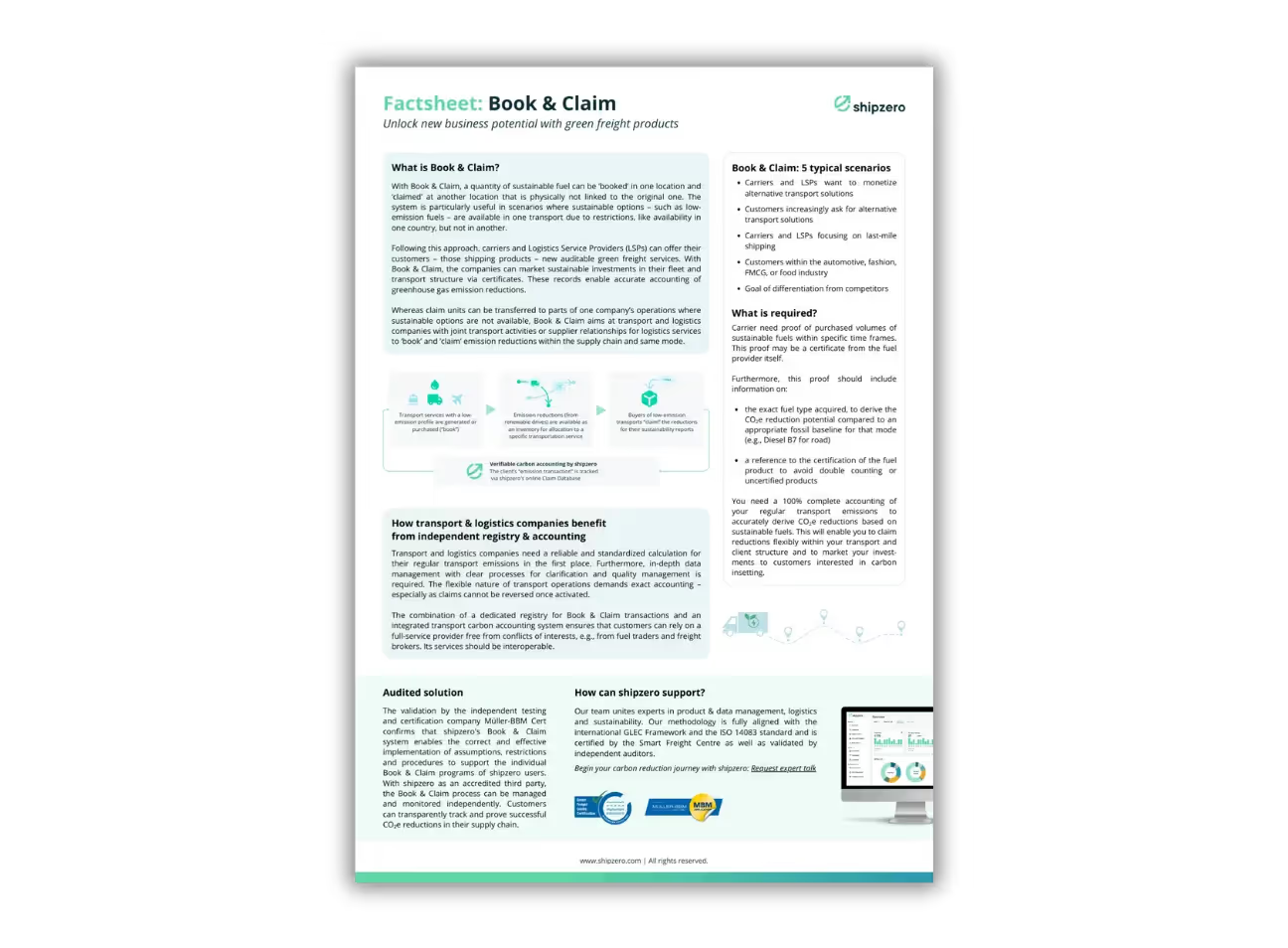
What is Book & Claim?
With Book & Claim, a quantity of sustainable fuel can be "booked" in one location and "claimed" at another location that is not physically linked to the original one. The system is particularly useful where sustainable options, such as low-emission fuels, are available for one transport but not for another because of restrictions, for example availability in one country but not in another.
Following this approach, carriers and logistics service providers (LSPs) can offer their customers, the companies shipping products, new auditable green freight services. They can market sustainable investments in their fleet and transport structure via certificates. These records enable accurate accounting of greenhouse gas emission reductions.
Claim units can be transferred to parts of one company's operations where sustainable options are not available. Beyond that, Book & Claim is aimed at transport and logistics companies with joint transport activities or supplier relationships, so that they can book and claim emission reductions within the supply chain and within the same transport mode.
How Book & Claim works
- Book: Transport services with a low-emission profile are generated or purchased.
- Allocate: Emission reductions from renewable drives are available as an inventory for allocation to a specific transportation service.
- Claim: Buyers of low-emission transports claim the reductions for their sustainability reports.
The client's emission transaction is tracked in shipzero's online Claim Database and is based on verifiable carbon accounting.
What is required?
Proof of purchased sustainable fuel
Carriers need proof of purchased volumes of sustainable fuels within specific time frames. This proof may be a certificate from the fuel provider itself. It should also include:
- The exact fuel type acquired, to derive the CO₂e reduction potential compared to an appropriate fossil baseline for that mode (for example, Diesel B7 for road).
- A reference to the certification of the fuel product, to avoid double counting or uncertified products.
Complete accounting of your regular transport emissions
You need a 100% complete accounting of your regular transport emissions to accurately derive CO₂e reductions based on sustainable fuels. This enables you to claim reductions flexibly within your transport and client structure and to market your investments to customers interested in carbon insetting.
How transport and logistics companies benefit from an independent registry and accounting
Transport and logistics companies first need a reliable and standardized calculation of their regular transport emissions. In-depth data management with clear processes for clarification and quality management is also required. The flexible nature of transport operations demands exact accounting, especially because claims cannot be reversed once activated.
The combination of a dedicated registry for Book & Claim transactions and an integrated transport carbon accounting system helps customers rely on a full-service provider that is free from conflicts of interest, for example from fuel traders and freight brokers. These services should be interoperable.
Book & Claim: 5 typical scenarios
- Carriers and LSPs want to monetize alternative transport solutions.
- Customers increasingly ask for alternative transport solutions.
- Carriers and LSPs focus on last-mile shipping.
- Customers come from the automotive, fashion, FMCG or food industry.
- The goal is differentiation from competitors.
Key terms explained
- Book & Claim: a chain-of-custody model in which sustainable fuel is booked in one place and the resulting emission reduction is claimed in another, without the claimant physically using the fuel.
- Certificate: a document that records the purchase of a quantity of sustainable fuel and its attributes.
- Claim unit: a unit of emission reduction that can be allocated to a transport service and claimed by a buyer.
- Registry: a system that records bookings and claims and prevents the same reduction from being claimed more than once.
- Double counting: the same emission reduction being claimed by more than one party.
- Fossil baseline: the fossil fuel used as a reference to calculate the reduction. Diesel B7 is standard diesel with up to 7% biodiesel.
- Carbon insetting: reducing emissions within your own value chain, as opposed to offsetting them elsewhere.
- CO₂e: carbon dioxide equivalent, the unit used to express greenhouse gas emissions.
- LSP (logistics service provider): a company that manages or executes transport services.
Dieses Fact Sheet auf Deutsch lesen









.svg)